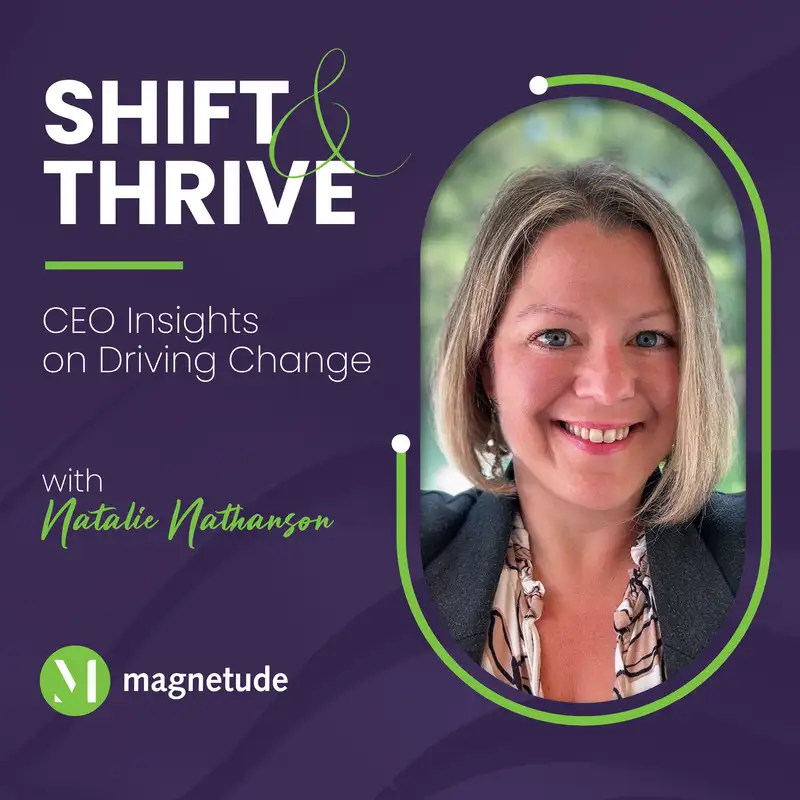
Why Listening Defines a CEO - Maximos Lih - Shift & Thrive - Episode # 081
S&T_Maximos Lih
===
[00:00:00] In today's business world, change is the only constant, and mastering transformation is the ultimate key to success. Welcome to Shift and Thrive. I'm your host, Natalie Nathanson.
Each week we'll bring you conversations with CEOs who delve into how they successfully drove critical change in their organization. This show is sponsored by Magnitude Consulting, bringing you the thinking power of a growth consult. And the getting it done, power of a full service B2B marketing agency.
Natalie Nathanson: Today's guest is an executive coach who works with founders and CEOs through pivotal inflection points, helping them navigate growth complexity and critical moments when leadership must rapidly evolve. To meet new demands. He spent nearly a decade at Google Ventures supporting a portfolio of over 600 founders, often immediately post series A or B investment, and helping them rethink how they scale [00:01:00] across these hundreds of companies.
He's seen firsthand how leadership must change as organizations grow and designing systems that can sustain scale.
Today,
his work focuses on helping founders design. The right cultural foundations, incentive structures, and leadership habits that enable long-term success. He is the founder of Emboldened Maximus.
Lee, welcome to the show.
Maximos Lih: Hello.
I'm glad to be here. Thanks for having me.
Natalie Nathanson: It's my pleasure. And
I know,
as I mentioned in my intro, you have worked with hundreds of CEOs and founders and especially. Many in these kinda high growth, high uncertainty, uh, stages where they might have, uh, or have likely outgrown, uh, what's
worked for them to
date.
Um, I know there's Alon of changes facing all of us in today's environment and Alon of, uh, founders and CEOs in particular are being stretched in lots of different and new directions. So would love to really start us off, uh, talking about some of the biggest shifts That you're seeing and You know what it takes to be a successful, uh, [00:02:00] CEO or founder today.
Can you talk about some of the patterns you're seeing that either maybe trap leaders or help them thrive in this environment?
Maximos Lih: Um, well, I, I wanna start off by saying it's an an incredible privilege to work with founders in any capacity, right? Founders are doing incredibly hard work and they in many ways have given up really great certain job promotions and opportunities to go and create something that they
believe.
Like has a missional value to exist in the world.
So it is always incredibly challenging, incredibly humbling and, and such an incredible privilege to get to work with founders. The, the privilege of being at Google Ventures was that I got to see Alon of them in classes and be able to do pattern matching from the perspective of seeing so many and post COVID, post ai, all of those shifts have become even more.
Trendly obvious
and urgently [00:03:00] critical. So I would say that the three things that I've observed, which are particularly interesting at the intersection of people and revenue, which is sort of my specialization is one, um, how we're seeing ecosystem level changes as companies scale. Sometimes I call this sort of like this, the playbook to ecosystem shift.
Uh, a really obvious example is as more and more people get on ai. More and more scams are going to happen. And so if everybody jumps on and uses it exactly the same way, it's actually going to create Alon of chaos. And I have a, a law firm that's trying to do that where they say, Hey, let's use, um, my associates to use AI for.
Discovery and research. And actually what happens is that there was so many hallucinations, there was so many compute issues that it actually required more cleanup. So you have to think about everything in terms of like, overuse can actually produce congestion as opposed to overuse creates, You know, this like hyper uh, a scaling, You know, J hook to the right.
[00:04:00] Um, and that actually had created Alon of really interesting issues. With respect to how we hire and how we lead, which is creating not just a shift in expectations, but dramatic increases in, uh, complexity, which is the second thing that I've started to notice. Um, we are increasingly companies with four or five different generations, which means that even a word like professional in the workplace.
I mean everything from, we have to speak about, You know, what's going on in politics to, I would like to be left alone to parents of young children who want to do no virtual happy hours ever and be remote and distributed. So what is a manager supposed to do when it comes to employee happiness? So fulfilling expectations.
Those things have now added, You know, millions of, of like, uh, dimensions of complexity and not significantly more training or role models. That you take it up the chain. Right. If that's true for managers, then it's also true for directors and it's gonna be true for CEOs and founders as [00:05:00] well. And I have this, You know, incredible executive director that I was working with, really struggling with her board.
And I remember asking like, what are your values? Let's talk about that. And she sent me four articles. One from Jeff Bezos, one from Brene Brown, one from Brian Chesky, one about Steve Jobs. I was just describing realization of you picked four non-overlapping archetypes, superpowers, businesses, right.
Industries, and they're all
filtered.
So this, um, like, oh, like instead of asking what's everything that you can do, right? What is the thing that only you can do? To like collapse. Some of that complexity becomes really important and that, that's a shit that I, I think we need to be conscientious of because the complexity's just going to overstimulate you all the time.
We have more access to that than ever before. And I would say that the third one is, um, uh, there are Alon of outdated. System [00:06:00] incentives for how things used to work that will not only become obsolete with technological advancement, but also become very toxic to your culture as a result. And so there's some examples, um, about how compensation works, right?
Where we've actually seen that now shift to, well, if I'm gonna be paying a new grad for such and such. I might as well just buy an AI tool and I don't need to do that. But what it actually incentivizes people to do is right, not hire new grads, um, knowledge board, do things that make themselves indispensable rather than collaborate.
And we'll see that affect the data of employee engagement surveys, not because the people have suddenly become bad, or because COVID made them bad or remote made them bad. It's actually just because the incentive structures that we put in place.
like so long
as you make your numbers, I don't care how you get there, is actually creating some of these outdated incentive structures and people will respond to what they're about.
[00:07:00] So those are the three really big ones, and I think that they're, You know, we're, we're in a good time to start to shift and think about what is the thriving question.
Natalie Nathanson: Yeah, I think there's so much there. And I will take us through, uh, one by one so we can unpack these. I think one kinda, uh, overarching question I have for you before we, before we go back to that, is, as you think about kind of the, the trait. or practices, uh, that CEOs kind of need these days, uh, to adapt to these environments, what are, what are kind of some of those learnable traits or practices that you're seeing that are, You know, most beneficial or most critical?
Maximos Lih: I think that listening becomes a really big part of, of this. So I would say the, the, the two things that have been true
of
all of my, like greatest founders.
One, they, uh, do not allow their executive team to work in a different office or a different floor from the, the ICS on the ground floor. Um, we know from research that you drop [00:08:00] 15% productivity when the execs move to a different building.
Um, and, uh, and, and I think Alon of that is because they just ruthlessly destroy silos, right? Um, and then I think the second thing is that they really are trying to provide, i, I, I call it like clarity. It could also be called guidance or direction or strategy. But the CEOs are helping people say no to more things than they're saying yes to at a time when the market is pushing urgency to do as many things as possible and throw everything against the wall.
So how do you actually provide, right? That kind of clarity. And, and not be afraid to get in the weeds or make it about design, right? Those four examples from that executive director, they were all from right leaders who decided I'm gonna be about one thing that I do really well, because that's what my team needs me to do, and not everything that I can possibly get my fingers conversion into, which could get people spun up and anxious more than I stay productive.
Natalie Nathanson: Yeah, [00:09:00] I think that saying no to more is so hard, especially for Alon of us entrepreneurs, right? Because you see an opportunity, you get excited about something you wanna take it on. Uh, but to your point, uh, there's so much coming at us that it's more volume than anyone can handle. Uh, and for many organizations, like the reality is we're in a time where we need to adapt and evolve.
And whether that's organizational change, kind of product or service roadmap, You know, any of those areas Go-to-market, kinda structural changes. Um, and that takes Alon of work and Alon of things that really need to, uh, be driven from the top.
Maximos Lih: When I was at Google Ventures, I had an incredible, um, like future CEO, who was my manager and a partner. Um, his name is Rick Cloud. Rick Cloud's, uh, You know, at one time he ran both YouTube and Blogger at the same time at Google, so he's understand what it means to grow really high value assets. And there was an entire year where the catchphrase on his team was, we're gonna be like, and this is gonna date me a little bit, we're gonna be like [00:10:00] Harris Hilton, or maybe we're gonna be like Kim
Kardashian,
right?
People who get Alon of credit for doing things that they didn't have to build from scratch. And I think that that is something that is like such a, a wonderful mental model, right? Oh, you're doing good to market. You feel like you need to create seven to 14 different pilot products to please your customers.
Or you can say, we won't design anything where we don't have a paid co-designer. And that's actually getting Alon of credit for experimenting on things that other people are doing the work for you to leverage. And so, but it has to start with saying, well, I'm just not gonna hire people to scale out the opportunity.
I'm going to actually create, You know, structures of accountability or constraints systems that force me to say no. Because I know my personality is that I like to lean in with Yes. And I default to yes. And so if I didn't have those environmental systems, I would be tempted to just seize everything.
Natalie Nathanson: Yeah, a quick one I heard, uh, recently is just never say yes on the [00:11:00] spot. Right. Say thank you. I'll think about it, and then And give yourself the time
to kind
of look and reflect and all of that. And as a, a very simple rule of thumb, I can see that working well
Maximos Lih: and You know, and I, and I completely understand and empathize with, You know, founders of
20% person teams or
50 person teams or not, like it took me so long to just get this call. I have to say yes. That's where the, like the rules of improv apply, say yes and right. Yes. And we, You know, yes. And the trade off is this and it will require this, um, so that you constantly are keeping the momentum going forward, but you're not just giving in to what the customer asks.
And especially at a stage where you don't have all the power and control 'cause you're still building.
Natalie Nathanson: Uh, I wanna come back to, uh, what we're talking about in terms of shift in kinda how we need to lead and hire. And you brought up the point about, You know, the different [00:12:00] generations that are kind of in the workforce today. Uh, can you start maybe with a bit of, uh, of background or context so we're all thinking about it?
Uh, in the right way. Like, what are those generations and from a high level, like what are some of those um, big things that, uh, we should know about them? I know it's, uh, we're gonna go into stereotype territory here, but Uh, just to help frame it for everyone,
Maximos Lih: You know, I, and, and
I I could
probably talk about them in fairly broad strokes just about how different things are. But You know, you look at companies today, the leadership structure is predominantly people who are sort of in the boomer generation 50 and over. Um, I even have a number, uh.
C-suite folks that are in their sixties and seventies, particularly for industries like biotech, where that experience is really hard one, and they're not ready to retire, thank goodness.
So they're coming in to help these companies. And so then you have one generation who's accustomed to thinking about work-life [00:13:00] balance in a very, very specific way, thinking about boundaries in a different way. And our past, um, the parenting of child, uh, young children. Then you have right generations of people who are in the sandwich generation, where they're taking care of both elderly parents and raising children.
So that can be the X generation. They really graduated in a, in a, in the midst of the.com. Uh, sort of like collapse. And so they have a different kind of understanding about work and stability. And you have, uh, millennials who are, uh, more often than not now, just starting to have children. At a time where childcare is more expensive than ever, predominantly two, uh, working parents and, uh, struggling Alon with community building loneliness.
They don't have their parents around with them to be able to help care for children. Um, live through COVID at a time where you couldn't even pay a babysitter to come if your kid was sick. Right. Um, so you're, you're really used to. [00:14:00] Um, being on camera for a meeting with your kids, playpen in the back, right.
Or your mattress bed unmade in the back. Similarly, right. Completely different kind of need for support. Completely different understanding of benefits and perks, completely different understanding of work-life balance. And then you have, um, people who are sort of like in their beginning. So I would say like two to seven years of experience hungry for mentors have seen, um, I.
I've
never known a non remote or distributed or zoom based culture. I,~ I, I was at a company where I was the people programs leader and we were trying to retain, You know, Stanford, like, incredible young engineer and we're saying to him like, oh, we're gonna bring people back in the office. We're gonna do sprints, we're gonna do offsites and hackathons.~
~And he kind of looked at me and said,~
~um.~
~Everybody talks to me about whiteboarding, like it's this magical thing. You realize that I've never done any whiteboarding. Right. And I was just like, what? And like,~
~yeah, like~
~I went through college during COVID. There was no whiteboarding. The, the Zoom whiteboard sucks.~
~Like nobody had strong enough wifi to be able to do it. I like, I don't get it. Um, and he ended up leaving the company because the things that we were trying to get him excited about, he had never experienced before.~ You know, and then you have people who are just coming out of college right now who are really struggling to find jobs, who, uh, understand that maybe the thing that used to be the software engineering is now in danger and they don't even know how to ask the right questions.
So like, am I supposed to be preparing my resume? Like am I supposed to be interviewing? It seems like people are throwing all those things away, [00:15:00] or the job postings that are online are not even real. So like, how do I even think about a career? Maybe I should just be an Instagram influencer. And there are literally people right in la uh, who are TikTok agents who will take 20% of your income to go and push you to millions of viewers on TikTok.
Be able to make a living that way. ~But, You know, I have a friend who's literally doing that. She clears, uh, $2 million a month. She is six foot four, so she makes content for like funny 32nd videos for tall people because the over six foot four female is not a saturated market. And You know, she's thinking about career and monetization in a completely different way than anybody else.~
And a manager with a team of 10 and a director with a team of a hundred or a CEO with a company of a hundred has to manage all of those people with almost no overlapping sense of, um, commonality in terms of like what they're expecting from work or what even it means to do your best work. So I think that that puts an enormous amount of pressure, right, and complexity on, alright, how do I do the right thing? Especially if you also want to say yes to the best people and they just end up in this place where it's like, oh, HR is pulling out their hair because they have to play therapist [00:16:00] and fire people and run performance reviews. Uh, or people to whom good performance actually has very little commonality in definition.
Natalie Nathanson: It's very interesting, and I'm thinking about the implications on, on hiring, on building teams, on nurturing teams. Uh, let me talk through the, the implications of those. We can kinda start with, uh, any of those areas. Uh.
Maximos Lih: Yeah.
I, You know, I, I use this as a catch phrase for myself and, and I also encourage all of my clients to do the same. 'cause I, I'm a coach and, and I think that it always starts with. Um, You know, it's what is the thing that only I can do versus all the things that I can do? And founders are humble. They wanna be servant leaders.
They, uh, started off with nobody else but themselves. So they're accustomed to doing a bunch of things and being able to hold all of it. Sort of like to say like, oh yeah, like, this is how I'm doing good. I'm being useful. I'm an achievement oriented [00:17:00] personality, and I love this, like, basket of things. And so then they tend to make themselves.
In the best case scenarios, spare buttons, right? Like, oh, like somebody needs this. They're complaining about this. Lemme go in there and fill this in. Oh, like they're really struggling with this. Lemme go in there and save them. And then I'll just give all the credit to the person who finishes the work, even if I have to be the hero to come in and like kind of save them from some of, some of their struggles and challenges or failures.
And, and I think that that actually. Um, always creates a negative consequence, especially on an ecosystem level because one, now you're saying to your direct reports, this is what you have to do to be successful. Our cultures take after to us as leaders, so like you will model a different work-life balance than they want.
And You know, there was this 9, 9, 6 right's because an entrepreneur
is
doing 9, 9, 6 is the first two years of their life and now all of a sudden their companies are all doing that and everybody feels so powerful. Uh, that that's one negative thing. Two, you actually very rarely start to ask them like, do I have the right people? [00:18:00] Like, what does my team need me to do? Do, am I missing anybody's skillset? Am I, and, and, and is this the right team to seize upon the strategy that I think we should go after? Um, And so it actually ends up being. You, You know, kind of dehumanizing to your team because what you default to is I'll just go in there and do it.
And What
a person on the other side receives in that situation is, oh, you don't think that I'm very qualified, or You don't have Alon of trust in me, or you don't want me to stretch myself. And that actually collapses, right? A company into the like, what is good enough as opposed to what can we shoot really high to do? So I think that that's a second thing that becomes really kind of challenging for the, the founder as well. And so at, at the end of the day, where I come back to that listening work is, well, how do You know you have the right people on your team? How do You know what your team needs you to do?
Um, right.
Like, are you doing the right listening work? And the listening work is [00:19:00] not listening for the market. The listening is how many people love care are invested in the company and its potential in the same way that I am. Um, which is a very different kind of listening, and it's a very different kind of conversation.
It's not a conversation that harvests complaints and discontents. It's actually a conversation that harvests right ambitions and dreams. And then you can say, oh, okay, I get it. What they lack in some of these conversations is not execution. What they act, lack is saying no, so that I need to be the person that says, no, 'cause only I can do that.
Or, Hey, actually people are afraid of layoffs. There's a little bit of a scarcity mindset. What I need to do is actually empower people to fail. Well. So I'll fail forward. Okay. Because they need me to do that and, and I think that that's the thing more than product operations, right? Vulnerability more than sort of like these archetypal boxes is actually where it needs to start.
What do the people that you have hired and put in place need you exclusively to do so that they can be their [00:20:00] best?
Natalie Nathanson: I like that and it's making me think of a, uh, a friend of mine, bill Flynn, who I had on the podcast, he actually recently his episode. Uh, he's working on a book with the concept of, uh, hero to architect.
So leaders needing to move from, right, like being the hero. I can swoop in and do what's needed and save the day. Um, and instead, right, how do you architect the right organization, the structure, et cetera. So I think about like the right people, everyone's in the right seats. There's clear ownership roles, expectations, um, and then you're, You know, fine tuning from there.
So I like how you're describing this and. the listening I think is so important on Alon of the podcasts. We've talked about the importance of listening to the naysayers, especially as your organization's going through major change
and
sometimes the best solutions can come from that, uh, hearing finding opportunities that.
Or not in your immediate purview as the leader because the people doing the work might be looking [00:21:00] at things, uh, very differently. Um, and then also like the areas that, uh, a leader doesn't understand as well, right? We're all only the expert in so many areas. So what are the functional areas? Um, so listening for.
Um, You know how it's changing, so you're making me think really, and all these different parameters, like what is the, what should the listening look like and what are like the outcomes that can come out of that?
Maximos Lih: I mean, I, I love that analogy, right to architect where you're, you're designing a, a building and then being able to host it so that many people can come in, be part of the structure. It, it, it is a really different way to understand how to scale yourself as a leader. But I, I also think that what's interesting is, You know, the, the, the conversation that I have when somebody comes into coaching oftentimes is, You know, I've doubled the size of my team, but I haven't doubled my productivity and I'm so frustrated with my people because of blah, blah, blah.
And,
And, we'll kind of go down the diagnostic path and realize,
well,
Part of the [00:22:00] unintended ecosystem, consequence of being a hero CEO, is that you don't actually need to lead grownups.
Right. Like there's something, it was like, oh, like, because then they don't have to solve their own problems because then there actually is very little need for accountability.
You're just trying to survive the crisis. If you're just going from fire to fire, you don't need to build a fire department. In fact, it doesn't even matter how good your fire department is sometimes. Right? So,
so it's like, oh yeah, like that's actually also. A, a significant shift to where the things that you're complaining about are actually your own blind spots.
And like listening to that instead of being frustrated with that will help unlock the things that would actually get you to the next level of architecture, right. For the thing that you aspire to be.
Hey, this is Natalie, your Shift and Thrive host. After chatting with lots of CEOs, one thing is crystal clear. Leveling up your company means having a killer Go-to-market strategy. That's what my crew at Magnitude Consulting does every day. [00:23:00] If you're trying to step up your marketing game, whether it's strategizing, accelerating your pipeline, expanding into new markets, or getting into AI and automation, let's talk.
No pitch, no pressure. Just good conversation. Visit shift and thrive podcast.com/natalie to schedule a time. Can't wait to connect. I.
Natalie Nathanson: how do you guide, uh, CEOs to kind of find their blind spots? I'm sure You know, I know some are stronger naturally than others.
Obviously, working with a coach, uh, such as yourself, uh, listening to your team, if they're comfortable sharing that. Are there other ways that you, uh, You know, tell folks to, to look for that or better understand that about themselves?
Maximos Lih: I, I, I am such a strong believer in coaching because I was coached because I was, uh, You know, I was a 20. Something guy in vc, I felt like I was on top of the world and there wasn't Alon of places where I could get my feedback and my metrics of success, You [00:24:00] know, were measured by like company outcomes and not individual right.
Engagements. And so having a coach really helped me. Alon to decipher my own sense of self-awareness and maturity. And, and I would say the two things that I have found to be particularly useful is, um, one recording or being in person to watch a staff meeting. So, um, very rarely is, uh, CEO's interpretation of the problem, also the root
problem. And so,
right, the CEO will come in and say, I feel like maybe I'm just not communicating properly. And it's because, You know, I'm not getting collaboration. I'm not getting sort of innovation that I want. You know, maybe it's just because I'm not a good communicator. Maybe you can help me sharpen that. Or sometimes they say, maybe it's because I have this accent.
You know, they'll go into a staff meeting and I realized. Um, you literally check your phone the entire time people are talking, and then when it's your turn to talk, you, you put, [00:25:00] okay. It has nothing to do with communication. Like it has to do with listening, right? Or has to do, people are scared of you. Um, or, or, or the opposite, right?
Um. I have a, a client, they're in cybersecurity and what we have discovered is that, um, if the CEO is really excited about a particular topic, he will text you at night before he goes to bed and like talk about the thing. And then you'll have like a secret ear conversation with the CEO and the next day you come in, you're like, oh, I've got this, like, new trusted charge and I am like a new person that's in the inner circle.
I feel great about that. And like, oh, well that's your problem, right? Your problem is that real work happens in these secret meetings outside of the staff meeting, and now you've incentivized information hoarding or you've incentivized being indispensable, and that will trickle down these ways that are actually quite toxic.
So I think the first
one is just like
ob, objectively observing behavior. The second thing is [00:26:00] that I don't think CEOs should do one way performance reviews. I think that there should always be a peer oriented, uh, performance review. There should always be a self-evaluation review and then the CEO review.
Um, and is. For two reasons. One, I think Jensen and Nvidia uh, said it really well. Like it's not the job of the CEO to be
a first line manager
and the CEO
of
a company. It's really hard to do both. And, and we talked about this, I think holding Alon of complexity and context switching actually sets up both sides for mediocrity.
So don't try to do both. Um, be the CEO be the culture carrier, but don't pretend that you're going to be the first line manager to like performance feedback. You're not in the day-to-day, right? So incentivize people to keep each other accountable with these like kind of peer things. And then two, it's really right, like make the performance reviews about driving alignment.
If a self assessment comes in from somebody who says, well, this is what I think my job description is, and I've really blown outta
the park, but it was completely wrong, where the board didn't agree, that's your fault [00:27:00] as a CEO, you didn't actually do the work that you needed to do to drive alignment. So rather than performance refusal or A CEO, like, You know, scratching their head with their c uh, with their ea, how do I find 10 hours to like write these things in lattice or culture or some sort of system?
Uh, just don't assume that you should be doing that first line manager work, or that you have the best perspective of their day-to-day operations. Um, and instead make it much more about, You know, alignment and accountability and stuff.
Natalie Nathanson: I love your point about, uh, kind of paying attention to, You know, how you're showing up in the meetings and, You know, recording yourself, that sort of thing.
I think back to, uh, one of my first roles when I first started giving, uh, presentations, um, and wanted to work on that, uh, the person, uh, kinda a coach type individual had recommended. Recording myself. And while it feels painful to watch at times, it's,
it's so
helpful. And then I think about, You know, with current technologies, like the meeting note takers, we use [00:28:00] Fathom internally.
Um, that can be a great tool for, right, like asking yourself those questions. Where am I jumping in unnecessarily? You know, how am I showing up in the meeting compared to my, my team? Um, so I think there's Alon that can be done, uh, in that way.
Maximos Lih: Uh, and I'll, I'll share, it's kinda like a funny example. I had a VP of sales that I was coaching who, um, the engagement surveys came back and some of it was just like cold, not empowering, disengaging. And we found that it was isolated to sort of like particular people who, who were just extremely negative about this VP of sales performance.
And so the, the board brought me in to go work and coach. Um, this gentleman and it's like talking to him and listening to staff meetings and it, it just kind of felt like something was awful. A little bit about the feedback because it didn't seem like he was called at all.
Um,
And so then we started to go down, right?
Is there like some [00:29:00] sort of bias, right? Is there unconscious bias at that point? And finally I just said, You know what? Like, we are now safe enough. Let me just fly out and like follow you around the office. And I realized every morning he would go to the bullpen and he would say hi to everybody and he would sort of like make his rounds.
But because he is quite tall and we know most VP cells tend, tend to be quite tall, um, be because the, uh, of the stereotypes there. Um, there were some people that just from a pure physical geometry perspective, he wouldn't be able to see that they were in their cubicle as he was walking around. And so then he would not say hi
to them. So
it was like, oh, like everybody that's, You know, shorter than five, six would never get to say hi to the CEO, but would hear him say hi to everybody else. And it was because from a geometric perspective, he didn't know somebody was in that cubicle. And so what do we do? We just took the cubicles away, right?
We gave people like quiet rooms and conference rooms and little pauses that were sort of like those phone booths. But the bullpen was not a [00:30:00] bunch of people in cubicles. It was like a geometry thing. And then it made the team feel so much more together and made everybody feel much more equitable. But it wasn't a blind spot that he would've been able to catch himself because it was like literally his body following him around, like kind of like quickly.
So
I do think, oh
yeah, like those types of things become really useful.
Even
unintentional blind spots have consequences, right? So it is always good to have those accountability instructions.
Natalie Nathanson: Yeah. What a, what a great story. And I think, like you said, that person might have been sitting in their Cuba. Goal saying, what's wrong with me? Should I go look for another job? Right. And it's such a,
Maximos Lih: Can you imagine? You're like, you have say hi to that person and that person and that person, and then it's like, oh, never me. And then that person
I totally understand. Right? And then the one opportunity, I actually share some feedback, I'm like, oh, I, I don't know what I did wrong.
They're so mean. Um,
Natalie Nathanson: Solutions can come from surprising places and, uh, and insights. Uh, Maximo, I wanna talk about a different area that, uh, [00:31:00] that you teed us up for.
And, uh, we touched briefly on incentives, and I wanna go a bit deeper there because we know, You know, what big of what, how big of an impact, uh, that has on the behaviors in a business. Uh, So can
you talk
a bit about. Uh, right. Like how to think about, uh, I guess creating and, and aligning
incentives and
maybe how that might look a bit different now than in years past.
Maximos Lih: Yeah.
Um, I, I have two really interesting examples I think for, for this community to think through. The, the first one is, um, I think that we need to start shifting and, and I see some great companies already doing the same thing, shifting from thinking about AI as a tool. AI as, um, so like, like instead of tool, tool based and AI implementation to human focused AI implementation.
And, uh, You know, there, there's like two really great examples of that. The first one that I'll, I'll kind of refer to is the way that we've been thinking [00:32:00] about AI implementation for customer service. So.
I told
the story before in other context, um, when companies shifted from pay for performance, which is the idea that everybody with the same job title and level gets spread out across, You know, a band and then the top 20% performance get to be at the top of the band, which can be anywhere from four x to 20 x larger, You know, in compensation than people at the low end of the performance or the band.
When companies shifted from paper performance to pay for impact, which is sort of coursely, You know, defined as how do the things that I do, regardless of my job title and level impact, what is top line priority for the company. We started to see really interesting changes. In customer service, uh, teams and, and productivity.
So a company like Expedia did this research where, You know, they discovered that a top performer, customer service agent would take a hundred calls per week [00:33:00] versus 20 calls for a mediocre customer service agent. And when they put right bonuses around that, they could go as high as 150. Um. So what happens then is that that productivity metric that gets incentivized with AI as a tool is, oh, your top performers will start to write chat bots and then they'll be able to cover 500 calls a week instead of 20.
And, but, but it will be with bots, it will be with all the sterile and quality complications of having a blocked customer agent. And you can see in an efficiency based ecosystem like ours, we.
almost all
of the customer service agents I now have are these sort of like benign bots. Yeah. Um, now Expedia basically said, wait, but as an online travel company, the whole point is that we wouldn't need to have Alon of agents period.
Why are people making calls in the first place? And somebody started to do research and they discovered that like 50 to 70% of the call were actually people [00:34:00] wanting email copies of their itinerary 'cause they couldn't find it on Right. And so like when they built a button on the website where you can click a button and like get an email
to you
and that eliminated 50% of the
calls.
which then also meant that you eliminated X number of jobs and then AI took them over and, and it had negative consequences to culture, to employee engagement, to certainly the job market.
And, and that's one way of thinking about incentives, right? Like, oh, actually it would be better for me to just forward all the email itinerary ones, give the tough ones to the new guy until they find further up the totem pole. That's my incentive structure that's based off of this, right? Metrics oriented, um, reward structure.
There's a Japanese company that saw a similar situation, asked a similar question, and, but they asked one more question, which is why are people calling in the first place? And who are these people that are calling for these things? And so they discovered the same thing. 50% of the calls were coming from folks [00:35:00] who needed email copies of the itinerary, but 35% of those were from people who were older.
Who were extremely uncomfortable with technology, who were lonely and used to having a human interface. So in addition to actually creating this button that allowed people to just email themselves, they actually said, we will no longer judge customer service agents by the shortness of volume of their calls.
It's actually much more effective. For us to be willing to take longer calls so that these elderly people, these people who are uncomfortable, get a really premium service. And what happens as a result? The customer service agents felt more purpose and pride in their work, and the lifetime value of that customer base actually increased by two to three x because they became brand ambassadors because they spent more com money with the company because they understood use cases that they weren't paying for, and now they actually were having to pay for.
That's the difference between, right? A purely metrics-based, tool-based AI incentive system versus something that's much [00:36:00] more human first.
Natalie Nathanson: I am interested
to hear how you think about, uh, like individual versus team-based incentives. Uh, because I think your examples are, uh, a little bit more on the, in the individual basis.
And I, I know we haven't talked about culture yet, at least, um, but thinking about like like creating like competition versus collaboration and maybe leaving sales aside, but how do you think about kind of striking that right balance of and at what level to drive incentives?
Maximos Lih: Yeah. You know, and, and, and I'll, I'll be honest and say I think we're seeing Alon of this work out in real time.
Um,
And so I, I haven't seen companies that are really great, um, at having solved this and worked out the answers, but I will say that the best companies are really thinking, if we kind of go back to ai, they are really thinking about, um, incentive structures with the sort of like [00:37:00] least experienced person in mind.
So they're really putting like no silos or knowledge sharing at the center of what that is. And I'll give you an example that there's been Alon of companies that are trying to do AI based coding. Some of it is creating really great stuff. Some of it's creating not so great stuff. AI is young, but You know, I would say there's like a good number of companies have
said.
Hey, You know, what has happened is that we're trying to use ai, but once again, new grads, they don't have any judgment. They create buggy code. They're not using AI more productively. So we just won't hire any new grads. We will hire people who are really experienced and that will collapse the five generations.
That will give us people who don't need that much training and we'll be able to turn out more productive code in this AI thing.
Um,
and then I have other companies that are saying. You know what, maybe it's not the job of a human or an engineering. I don't want my engineering teams to be doing any debugging or refactor at all.
In fact,
I only want AI to be [00:38:00] doing that. So if my new grads come in and they end up in, You know, unable to debug AI code, that's probably because AI needs to be doing the debugging themselves. So let me get my most senior architects together to create hooks and APIs and frameworks and like, sort of like agentive bots that basically have a supervisory layer where I tell the AI, build this feature.
To do this. Run your own unit tests ai, score the bugs on a scale from one to five, whatever is lower than three. Debug it yourself and run the test again until you fix it. And only the thing that the five level, send it to an experienced, uh, engineer to review before you push
it.
Right, and now all of a sudden I've created the system that I very easy to integrate a new hire into.
Use this thing that I've created for you as a framework, and then I want you to be as creative as possible and be really customer obsessed. And in fact, then it becomes the mid-level and senior engineers who have so much baggage about how coding is supposed to work, that they can't help themselves but get in the way and try to [00:39:00] debug.
And the new grads are actually like thriving and they're able to, You know, jump from two to $20 million with less than 50 people. I think that that's actually really interesting system level by team level incentive, right? Like how are you actually using the tool? Like instead of a tool-based thing, right?
Really kind of thinking how do I actually maximize and leverage the power of the team not to think in terms of, You know, two x or 1.5 x, um, or right? Like I used to have a data analyst team that created widgets and dashboards. What if I never had to create dashboards again? The information would just be at my fingertips.
Well, I would think about team and skill sets and competencies. Very different then, hey, let me take three of my best analysts and have 'em do a hundred widgets instead of 10 widgets, right? A week. So like, like those type of things. That's really exciting, especially as we. Are actually making the technological advancements that allow humans to do human things right, have judgment, right?
Um, dream, You know, innovate, collaborate, [00:40:00] and then, um, forcing the machine to be its own worst, uh, critic and fix
itself.
Natalie Nathanson: I like that because it, I think it really drives towards like having an openness to think about your team and how you structure it, what the different roles are in like a fundamentally different way than kind of what we've known before.
And I think that's a charter that, uh, that lots of organizations should be thinking about.
Maximos Lih: Oh yeah, definitely. I, I think not hiring new grads. It's something that I've seen Alon in the last two years, and I, You know, know less than 20 friends who have actively moved to Taiwan, Singapore, Dubai because they can't find jobs here. And those are the types of things where I'm like, oh, but actually you might be reinforcing.
A productivity or functional area of blind spot by not inviting those new people in to check your system or to ask the tough question or just be annoying. Just be ly
like,
like un underexposed to how things are supposed to go. [00:41:00] Um, and we will see market impact of that not this year, but certainly in the next three to five years.
And so like, think definitely I, I love that question. Not only on the individual level, how do I empower, incentivize my 1%, but. Right like that. What are the teams doing that only they can do that I can actually leverage in?
Natalie Nathanson: I wanna shift gears a bit, maximos, and hear a little bit more about you personally. So, uh, would love to hear, You know, from your, your childhood or earlier in your career, are there any, uh, kind of shaping stories or, or anecdotes that helped, uh, signal you towards, You know, where you would go in your career?
Maximos Lih: Yeah. Well, I,
I, am very much, uh, inspired and, and, uh, formed by my grandfather, my, my father's father.
So I'm, I'm Chinese. I was born overseas, I immigrated here. Um, my dad was getting a PhD in [00:42:00] electrical engineering at uc, Santa Barbara. But growing up, the story that we always told over and over again, this like hero that was in our family was my grandfather.
My grandfather wasn't orphan. He was dropped off at a Buddhist temple in a small village in China, has a baby. Um, and, uh, growing up because of his, like lack of parents and because of his identity, Alon of people were constantly accusing him of being a thief for right, having bad DNA and having bad genetics, until finally when he was 14, he decided he was really fed up and he like ran away and joined the military, lied about his age in the next 30, 40 years of his life, he taught himself to read.
He taught
himself math. He taught himself how to dress. He was like, really like the best dressed person in my entire family. Like
I like sketches on paper when he like went to Paris to get his clothes tailored.
Um,
and uh, developed an appreciation for art and music. At the end of his career, he was a fourth [00:43:00] star general in the quartermaster division, and then after he left the military, he became the administrator of a veteran of a VA hospital for people suffering from PTSD after World
War One, world War
Two. Um, and, and I carry that heritage very proudly because it is such an example of how hidden potential works and how different kinds of people, right, within like, I I, we never talk about that as like a pull yourself by your bootstraps story. We always talk about it as the, the right environment will either bring out the best of you or accuse you of something that maybe was never part of you in the first place.
And so in our growing up, we, we constantly talked about make sure that you are. Systems. Right. That understand and value you and will bring out the best in you. Because that was my grandfather's story. And he, like, if he had not been surrounded by people who loved art, he would never have done
art. Right? If
he was not surrounded by people who love math or somebody who paired enough to teach him [00:44:00] how to read. There was no automatic literacy program in the military. Um, but he, he had those people who invested in him and he became sort of like this person who was, um. By the generosity that he had experienced and been formed by.
And so, uh, it, it was to the point where my father went to China. This is about, uh, five or six years ago now to visit the ancestral village where my grandfather had been and like a 50 person village, You know, very, very small rice field and stuff like that. And he was on the street and somebody stopped him and said, you're not from around here, you're a stranger.
What are you doing? You know, are you casing the joint? Are you, You know, enemy? And he was like, oh no, I'm visiting my father's hometown. His name was this. And the guy goes, oh my gosh, your dad saved my dad's life. You have to come and stay over at my house. And they
like went
to his house and had dinner.
And this like older gentleman came out and just told story after story how my grandfather was such an impactful leader for him. So, um, I, I carry that right as part of like, oh, okay. [00:45:00] So who are the other people?
Who would become
a completely different picture if we created the right environmental cues around them.
Um, and how do we actually do that in a way that, um, respects the dignity of everybody. And, and then I would say the, the second thing is I, um, so I did my graduate work in classical civilizations and Greek and Roman civilizations. Um, and, uh, so I like very obsessed with culture. And I remember going to my first interview.
At Google. Google. And You know, Google at that time was very specific about how they were hiring. They had developed an entire machine and it still is kind of a
machine today.
So an interviewer came in and said, are you an employee referral? No. I was like, uh, did you study computer science in college? No.
It was like, thank
you very much. Your next interviewer will be in shortly.
And then, uh, the next interviewer came in and asked me a bunch of questions about recruiting. And I, [00:46:00] and I was like, You know, I don't know anything about recruiting. I just know more than anybody who care to know about the rise and fall of the Roman Empire.
That's what I know. And that interviewer looked at me and she, she said, oh, good. That's what we're afraid of. You should come here and do that. So they created a position for me to be a data specialist on the talent team so that we could hire people that did not scale ourselves to mediocrity, to protect against the
Empire.
And so I think that's like those two things together that gives me my lens on, alright, right? Like if we, if we have a culture of people that spend 80% of our time at work, how do we build the environment
that actually
creates greatness? If we have been the most successful economy for X number of decades, how do we not scale ourselves to mediocrity, especially at a time when the nature of AI is democratizing advancement in a way that what came before will not sustain [00:47:00] success or necessarily be useful in what success looks like in the next generation.
So those, those are the things that I, I think, Alon about.
Natalie Nathanson: Yeah, those are two really great ones. And I think the story about your grandfather is, uh, so inspiring. Like I'm always so impressed by, uh, people that have been persevered, uh, through situations like that, and they created their own opportunities and realities.
Uh, it's not always, uh, entrepreneurial, but it is that kinda entrepreneurial. Uh, mindset. So, uh, I think it's, it's fascinating. And I think, uh, secondly to your point about, uh, mediocrity, uh, I say that all the time that, You know, these days, like mediocrity is commoditized,
right?
And so anyone can, You know, put a quick prompt into chat GPT and creates something that sounds good.
Whether it is good or not is a, is a different story, but. That's like become table stakes. And so now it's uh, right. How do you think, how do you take all the knowledge that you've amassed in your, in your [00:48:00] career, in your life and apply it towards, uh, what you're working on? And that's something that nobody can replicate because everyone has their own set of experiences.
Maximos Lih: absolutely
right.
Yeah. And,
and I think that there is a, a responsibility that we have as people who have. I've been privileged to learn anything or have anybody invest in us to also turn around and share and be a service to, to pull up somebody
behind us. I think that's really important.
Natalie Nathanson: so we only have a few minutes left.
Uh, I have one more question for you and maybe a bit more, uh, introspective is knowing everything You know now, if you were sitting in the room with your younger self as you were first, uh, entering the workforce, what advice would you give yourself?
Maximos Lih: Oh
my gosh,
not I, I think Natalie just, he just reminded me that I am not very good at looking back at my younger self.
I, I would say, uh, that for all the [00:49:00] times that I was, uh, really hard on myself for the things that I, I think I let people down, um,
ju just to be very aware that like, uh, no learnings are ever wasted.
And, and I do, I'm trying to actively do that more today, but I, I think having that constant practice of gratitude.
is,
is something that is really important that I would tell myself to do.
Natalie Nathanson: I
think that's a really great one. So thank you for that. And it's a great, uh, place to wrap up our discussion. And as we do that, can you let our listeners know how they can reach you?
Maximos Lih: Yeah, I'm predominantly, uh, I'm most active on LinkedIn. Um, and you can always email me. I check my own email. My, my EA doesn't do that for me. Uh, my LinkedIn, uh, profile is just Maximus Lee, so LinkedIn slash in slash maximus Lee, and you can always contact me on there. We'll have to chat with anybody who is building interesting companies.
Natalie Nathanson: Wonderful, wonderful. Thank you. Um, well, I really appreciated all the [00:50:00] insights that you shared in this conversation and.
Uh, loved the, uh, conversation around the generational shift and You know, what to be thinking about, to build an environment that, You know, draws on the best of the different kind of perspective or segments we have in our workforce. The conversation around rethinking, uh, incentives, especially in a world of ai.
Uh, so thank you for, for everything that you shared.
Maximos Lih: Well, thank you so much for having me, and I, I'm really excited to be a part of this community.
Natalie Nathanson: Wonderful, and thank you too to everybody that's listening. If today's conversation sparked something for you, and I'm pretty sure that it did pass it along to another leader, we know that insights like this really help fuel fresh thinking and help us all drive transformation, both in our organizations and in ourselves.
So thanks again, Maximos, and this has been another wonderful conversation on Shift and Thrive. I'll see you all next
time.
That's a wrap for this week's episode. For show notes and more visit Shift and thrive podcast.com. [00:51:00] A special thank you to our sponsor, magnitude Consulting, bringing you the thinking power of a growth consultancy and the getting it done Power of a full service marketing agency to help B2B companies fuel their growth.
For more information on magnitude and to get your complimentary transformation readiness assessment, visit magnitude consulting.com/. Get ready. Thank you so much for listening. We'll see you next week.
Creators and Guests