Voices That Lead: Shift & Thrive - International Women's Day Special - Episode # 087
International Womens Comp
===
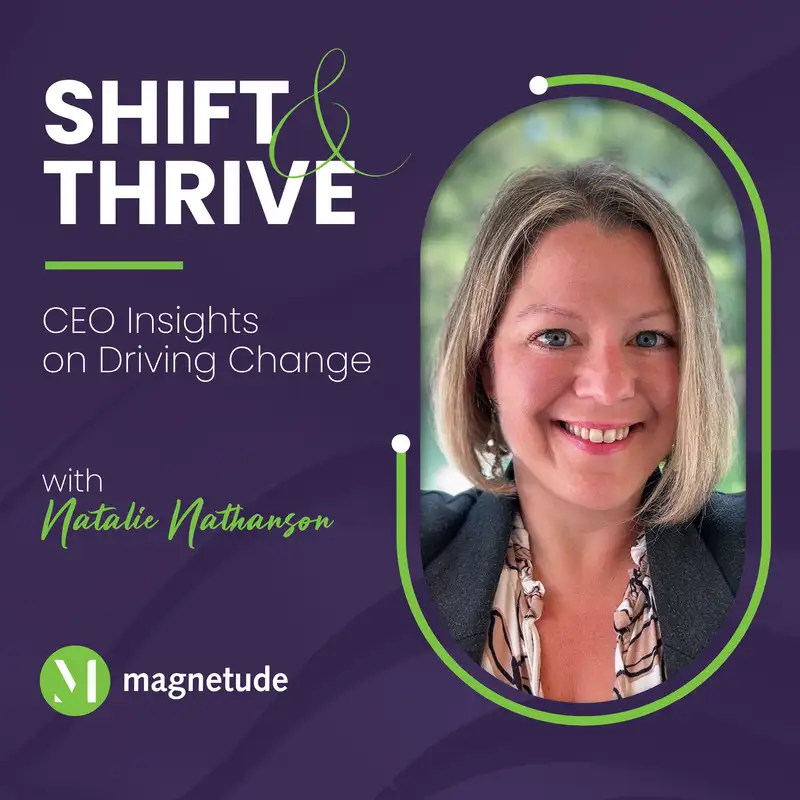
[00:00:00] In today's business world, change is the only constant, and mastering transformation is the ultimate key to success. Welcome to Shift and Thrive. I'm your host, Natalie Nathanson.
Each week we'll bring you conversations with CEOs who delve into how they successfully drove critical change in their organization. This show is sponsored by Magnitude Consulting, bringing you the thinking power of a growth consult. And the getting it done, power of a full service B2B marketing agency.
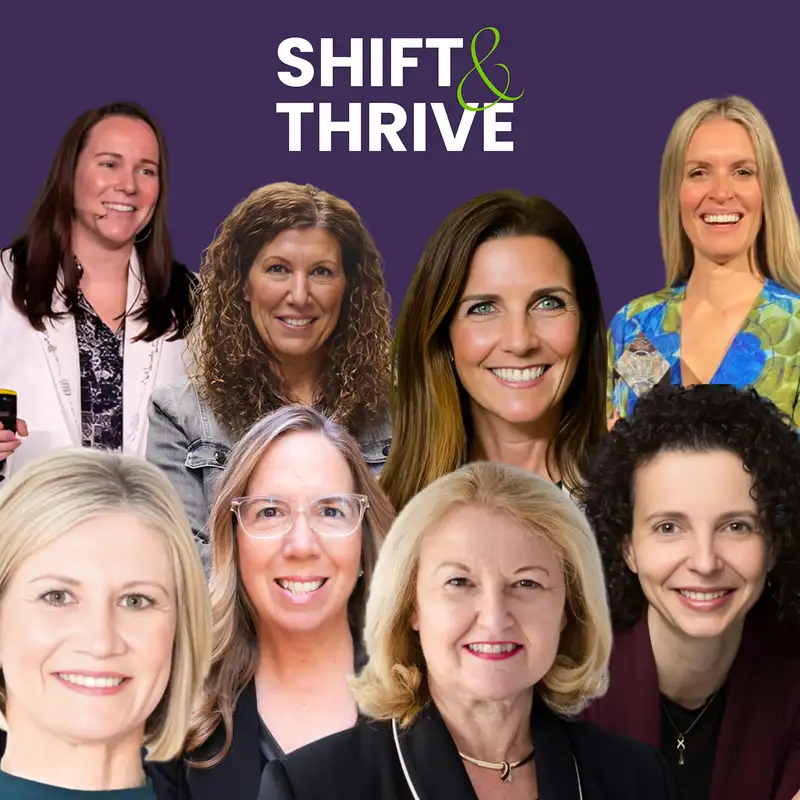
Today's episode is a special one. In honor of International Women's Day. We've curated a compilation of powerful moments from past conversations with some incredible founders and CEOs who have joined me on prior episodes of Shift Thrive. Before we dive into their voices, I thought it would only be fair to share some personal reflections as well, and specifically what this day means to me personally.[00:01:00]
I've spent much of my career building and leading in industries that have historically at least been male dominated. From spending my whole career in the business to business tech arena many years, specifically in and around the cybersecurity space, and lots and lots of time in my various founder and CEO circles.
And while I never really wanted or tried to lead like anybody else just to fit in. I'll also be honest and say that it took me, a few years into running my marketing consultancy to fully trust my own instincts as a leader. And that's after having had a, a prior career, in corporate leadership roles.
And I found that, You know, after time and time again, my gut proved to be right. And then with that came the confidence to fully show up as myself and not who I thought a CEO and founder was supposed to be. Looking back, You know, I founded my company in 2012, and then less than two years later, I became a mom for the first time.
And so in many ways, I've really grown this [00:02:00] business while raising my kids. And one thing I've learned as a leader, both professionally and personally, is that our definition of success isn't static. It can evolve. Our priorities can shift the things that life throws at us, make us who we are and how we show up as a leader and really help us bring all of what makes us ourselves, uh, to that.
We also know that good leadership is about making conscious and deliberate choices and then owning them and ideally being very proud of them as well. Uh, even knowing that some of the most important decisions often require trade-offs. So the conversations you're about to hear were not recorded for International Women's Day.
They were regular discussions on my show about building companies navigating growth, leading through complexity and change. But when I stepped back and really listened to what all these women shared, what stood out was the caliber of leadership in these women, their resilience, their clarity, their willingness to evolve, and their refusal to lead by somebody else's standards.
This [00:03:00] truly is an extraordinary group of women and leaders. And the insights they share are not at all about gender. They're about what it really takes to build and lead. So with that, let's dive in, and I hope you enjoy them as much as I did.
Natalie Nathanson: what would you say are the top takeaways that other CEOs would benefit from hearing?
Marcia Daszko: the really different and and qualities that the transformational leaders have are two things, very, very simple. In my first conversation with them, we talk about this. In order for me to help them transform their organization and deal whatever issues they're facing, their challenges, the reason they called and so forth, they have to be number one, open to learning, really committed to more learning.
So that means they are [00:04:00] naturally curious or have to really pivot their own thinking and get more curious about everything and really challenge their beliefs, assumptions, habits, the way they've been doing things. And then number two is they have to have the courage to apply their new learning. So that is, and they, they're not always sure they have it.
I know no one is to the level that they need to go deep inside because. To transform. It's a personal transformation first, and then an organizational transformation.
Kristina McMillan: So I just, uh, I
am deeply passionate and write Alon about, um, supporting ambitious women to achieve their goals.
And I think one thing that I get really excited about and that I've advised, um, uh, female executives, female entrepreneurs, female founders on is, [00:05:00] um, never before have we had the opportunity to be able to step forward materially and create a competitive advantage to try and normalize and equalize
World
in that way.
And I think AI provides that. So I've been advising Alon of folks to, to look at it this way. Um, most of organizations measure.
um,
Success in a person's ability to develop good ideas and disseminate them. And often when we have lots of good ideas, what we don't have time to do is put together that deck, right?
Or put together, You know, um, flesh it out so that I've, I've done the brainstorming
to think
about the impact of those ideas and then to, again, create that, those assets to, to talk to my team about them, and then figure out the operational plan to then go enact them. That all takes time. Then that
cycle, we're,
we're gated by how fast we can move ideas through that cycle.
Often the people that move ideas through that cycle the
fastest aren't
necessarily the smartest, but the ones that move it through
the [00:06:00] fastest
tend to have the best outcomes. And so what AI can do, and what I'm encouraging Alon of women to really lean into is all of those ideas, all of those great things that you wanna go do, leverage AI to get the idea fully through that cycle, figure out how you're going to use it to frame the decision,
um,
to flesh out the idea, to create that operational plan, to then, um, uh, create that story narrative for the organization and then get it into play.
I think there can be a massive, um, equalizer. And then I, I am encouraging Alon of folks too, to think about it in terms of how do I make myself the best. Whatever it might be, CEO, founder, CMO, whatever it is, AI can help you as like a, a support team that you don't necessarily have, right? So things like creating an AI copy of yourself.
Um, not, not in like
a cyborg kind
of way, but in like a, how do I mimic my own brain to create a [00:07:00] second brain that I can then converse with. So giving it context around what my role is, what my challenges are, what things I'm thinking
about, and
have it ideate with me or help it do my thinking in advance of a meeting to be able to be super crisp and clear
in that
meeting.
So decision framing or pre-thinking. It can also do things like, um, help me write up and frame my ideas in
a, in a
strategy much, much quicker. And that could be things like emails, it could be things like, um, literally just getting my thoughts down because often, You
know, I'm,
I'm a big believer of the school of thinking is writing. And so the, the
more I
can get that stuff down,
the better.
And then it can do things that we just
are,
breaks our brains. So things like it can analyze patterns that we are not necessarily able to see as, as quickly as AI might. So it might be looking at, um, I don't know, the transcripts from all the status updates on a certain project and it can start recognizing when we're like falling behind.
It can start recognizing like, this has [00:08:00] been a problem now for a while. So instead of us having to tax our brains to constantly do that, we can. put Some of that cognitive burden of that pattern matching
onto ai.
So there's just so many use cases for how it can just make us a more, um, robust and prepared and, um, thoughtful strategic executive that I think it's a huge opportunity that I would encourage anyone to take advantage of.
Adi Klevit: That's right. I mean, here's my strategic, um, plan for the next year. Where do you see it'll fail? Where do you see the, the weaknesses? I mean, this is the strategic plan and those are the resources I'm going to use. Where, where is it gonna fail
Natalie Nathanson: Mm-hmm.
Well, and
it's like
Adi Klevit: or what is not strong
Natalie Nathanson: yeah,
Like a, a sounding board or like business advisor that you can always just pick up the phone and, you know, here's my idea.
Like, help me, help me unpack this. Um, but because it's technology, you can, uh, pull it up at any, any time of day.
Adi Klevit: That's true, but you see, it's, it's a good, I mean, I still need that. I need that con, like you and I having that conversation. Because no matter the AI is [00:09:00] not going to replace that. It's not gonna replace the human, the emotions, the creation, the all of that, that we cherish so much. So for me, you asked me also how I use the ai, but also on top of it, I've been much more.
Connected to others personally, in person and in person meetings. Like you hosted the wonderful dinner that I attended in, I mean, I flew all the way to Boston for that because I still have that craving for that human connection that you can't find anywhere else. It's not the relationship with the ai, it's not really a relationship.
It is a machine. It can extract things. It can be. It can be, instead of me talking to myself and thinking about my ideas, you know you still have somebody that in a distance and you can look at your ideas and see if it's good or not. And it can bring up, according to data that it accumulated from somewhere else, it can bring up ideas that they might not have thought of, which is great.
So it's a resource, but the connections with other CEOs, with other entrepreneurs, with other leaders is very, [00:10:00] very important and we can't let go of that.
Natalie Nathanson: I'm very glad you brought that up because I do think it can be tempting to kind of stay in, in your own world and especially depending on, you know, busy schedules or if you're more introverted or whatnot. But you do end up in a bit of that echo chamber regardless of how well you can use an AI in those areas.
And I think in general, like we're coming from a very digital heavy, uh, mode, right? And especially looking at COVID and there's a lot of people, right, spending more and more time in front of, uh, screens, but. In times of change and disruption, uh, hearing from others and what's working for others and bringing new ideas in, um, I, I get so much value from that as well.
Adi Klevit: Absolutely. Yeah,
I agree.
Natalie Nathanson: I. I'm curious before we wrap up the conversation, as you think about, um, uh, kinda the, the demands on, uh, kind of SMB executives these days and the journey that you've been on, any kind of tips or [00:11:00] advice, uh, for folks looking to kind of best, uh, best harness, uh, AI for use for themselves?
Maybe folks that feel like they've, they're maybe a bit behind in their adoption.
Adi Klevit: Yeah, I think it's like you have to assess and evaluate where you are at. And take the next step. I'm, I'm, I'm a big believer of the next step. Whatever your next step is, do something to a win. Like accumulate those small wins. So if you've never used charge GPT, which are, I mean, I don't know, maybe there, there maybe it is, uh, maybe you are, uh.
Maybe there is an aversion to it. Maybe it's fear. Whatever it is, start using it. If you're not, if you're using it and you feel like you're not using it enough, watch a video, figure out some prompts and start using it. It's just, it comes with use using it and have the willingness to use it.
Kimberly Smith: I
was doing something. And every time I was in a, new role, you know, I approached it
with everything
that I had, but over time, I just, this,
this,
this sneaky, like this
little
[00:12:00] voice inside of me was like, this, this isn't it, this isn't it.
And I just kind of like push it down. And so, so when the time came. But I was
like, you
know, maybe I'll look at something new, an opportunity would arise, but of course it'd be in the
same line
of work, and I would justify it somehow. I would say, well, it's a little different
because of this and maybe it'll change.
Um,
and so, uh, I continue to do that throughout my career, and it wasn't until, uh, I gave birth to our second child. That I actually,
I got
laid off while I was on maternity leave. There were layoffs across the country and that ended up being such an incredible gift to me
Because
it allowed me to take a step back and fortunately I have.
An incredible partner with my husband and financially, we, I recognize we were able to make
this decision.
Not everyone has this, but I was able to completely switch gears and go after something
that felt
a little more fulfilling. [00:13:00] And so, uh, miraculously, I found Copia and to be frank, the first week I was in gap.
I was at the gap headquarters in San Francisco. And I was on whichever floor with the cafeteria and we were meeting with the, um, San Francisco Department of Environment and
a couple
of other government entities and the culinary staff
and we're
sitting there and we're in the back of the kitchen and, um, everyone's got their hair nets on and the clipboards and just the year prior.
I had been on the call
it 18th
floor negotiating a multi million dollar contract and here I am in the kitchen Talking about food waste and it was I had this moment going. What did I do? because of the social Expectations and misnomers that are out there and I had just taken a step back
In my
career financially, and now [00:14:00] I was working with a whole nother subset of, of, um, stakeholders.
And I sat back, I thought, Oh, gosh, did I make the right decision? And I could tell you what, Natalie, thank God I got through that day. Because what an eye opener for me. What an eye opener that like at the end of the day, there's so much more to business and out there
and problem
solving and Impact you can make in this world if you allow yourself to kind of shut out, you know Stereotypes or misnomers and I can't tell you I think food waste is
the sexiest
thing ever right now Like let's solve this.
I can't stop talking about it This is a very real problem like no one, you know, you grew up
at least
in my generation
Talking
about the trash man and it's like, yes, I want to talk to every person that works
at waste
man, a waste management company. I want to understand what the impact is that these landfills and I'm going on a tangent and you can tell that I'm passionate about this, [00:15:00] but there's so much good that we can do and I'm grateful that my path led me to where I am today and it wasn't just a clean cut way, but it was absolutely worth it.
Natalie Nathanson: uh, you know, knowing what you know now and kind of growing into the, the CEO role, uh, what advice would you give your younger self in your first ever leadership role?
Jenn Azar: Yes. Um, probably to take risks because that's the way you learn. So sometimes conforming isn't, uh, isn't all good. Uh, so you have to have enough confidence that you can take a risk and, uh, if it doesn't work out, own it and learn and pick yourself back up. Uh, I think it's also how you become more resilient, uh, If you fall down a bunch of times, um, you learn how to get back up.
Uh, so I wish I, I started taking more risks probably halfway into my career, but I didn't take enough in the beginning, I don't think. [00:16:00] Um, and then, um, the one other thing is just, uh, smell the roses, celebrate a little bit more. Um, uh, it doesn't have to be huge wins, but, uh, at the end of every day, um, my new practice is tell me something good.
What's one good thing that happened today, uh, in a world, uh, full of unhappiness? Uh, sometimes we don't celebrate enough, so just find things to celebrate
Natalie Nathanson: I love that. I love that. And it goes back to the, you have to laugh as you're going through the hard stuff, because sometimes if you don't laugh, you'll cry,
Jenn Azar: or kill
Natalie Nathanson: you're better off, you're better off with the, with the positive side of that. Yeah. Uh, it's interesting what, you know, what you said about taking risks.
Um, that's certainly been a lesson for, for me as well throughout my career. And I do consider myself a risk adverse entrepreneur, which to some people feels like an oxymoron. Um, but I've learned it just really, really quickly. Really requires, you know, pushing myself outside of my comfort zone more than if I were a bigger risk taker.
Right. And those are the [00:17:00] kinds of things we learn about ourselves over the years.
Jenn Azar: Yes,
Natalie Nathanson: Yeah.
Jenn Azar: absolutely.
Sarah Lehman: I always
thought
that to have an impact on the world, you had to either be a doctor or a teacher or even a politician, because that was the only way to have positive impact and by working with her and watching her start a company in the biomedical services industry.
I realized that business was a vehicle by which you could have a positive impact. And so I was hooked into business by that moment. And from there, I applied to Harvard business school, and that's where I met my husband and my trajectory into the journey that I'm on today. Has been extraordinary. A couple of lessons.
I've learned along the way is, you know, careers are not linear. They're more like a jungle gym or a euro pass is what I used to say. I thought when I started my career, it was gonna be like a bullet train from here to here to here and it's going to move super fast. And when I realized it was more like a euro pass, I
mean, I'll get on and
get [00:18:00] off, go all over the
place.
I took
five years off to have my Children. Thought for sure that was the end of my career. Had to reinvent myself multiple times. So, you know, I've learned that careers are not linear. I've learned that you have to be agile and adaptable. She who is the most agile and adaptable, I think, wins. You have to make decisions with not all the information.
Um, I don't think you can let your skills go dry, even
if
you do take time off. I think you have to keep up with the technology because it, even
two years
Of time off technology moves so fast that I was in catch up mode. So I think there's ways that if you do take time off. You have to keep staying fresh so that when you do want to get back on the ramp, um, you're not making up
for lost time. And, you know,
the journey's hard. It, it's always hard. I think the biggest lesson I've learned is it, it's, it never gets easier. It's just your ability to handle the hard gets better over time. And so that's a little bit
of
my journey [00:19:00] now.
Natalie Nathanson: What
lessons would you have imparted on yourself?
So looking at kind of everything you've accomplished now, as
you think
about yourself in your first leadership role, what lessons would you have given yourself?
Sarah Lehman: Well that's a wonderful question. I believe magic happens in the extremes.
Natalie Nathanson: right?
Sarah Lehman: Sometimes a good, sometimes a bad, but that's typically where the magic happens. And what I would advise my first time CEO self,
that a
Sarah who treats herself like an elite athlete is more productive than a Sarah who
is
trying to sprint America is trying to, um, work and amass the most output. And what I mean by that is when I first started at Envy, you know, I had, I must've pulled all nighters. A couple of times a month. I mean, the mechanic, the maintenance man knew that at four o'clock in the morning to come just check on me because I was sleeping in my office.
And while I [00:20:00] was wildly
productive and out, my output was super big and super strong.
I don't believe that it afforded me the time to take myself out of the business to make connections. And there were certainly times when I made emotionally based decisions because I was simply exhausted. So now. So I treat myself more like an elite athlete, like no self respecting Olympian trains hard every single day. They take moments of recovery, they take care of their mental health, their physical health, their spiritual health, their physical health. So I create a lot of what I call active recoveries. In my schedule, you know, working out every day, taking a couple walks every day, building in smaller minutes to have active recovery.
I don't need a lot, but I need some, and that affords me to have more stable, [00:21:00] constant response versus being
reactionary.
Right. So creating that space
between the stimuli and the reaction is super important. And I've just learned that you can't take it for granted. Self care is not an indulgence. It's a requirement if you want to act like an elite athlete at the highest levels of your career.
So that would be the
advice I would give my
first self. I used to think it was selfish to do the things that I just talked about. Now I think it's a necessity.
and everybody
benefits from
it.
Natalie Nathanson: I'm wondering, are there any personal transformations that have impacted you professionally that you'd like to talk about?
Anne Hartslief: Oh,
so, so, um, many, um, I think I'll probably start with the biggest one, which is the most recent personal transformation and one that I am still in the middle of, and that has been a cancer diagnosis that got handed to me two years ago. I was My fittest at my [00:22:00] healthiest, and, um, you won't believe it, Natalie, but in preparing for this, um, podcast, you have given me the great fortune of putting another piece in the puzzle of this diagnosis.
And I'm going to come, come back to that. But I was at a time in my career where I thought I really had it all figured out. I was flying, I was doing wonderfully well. And then this diagnosis hit and all of a sudden, um, This transformational piece was so up in my face because you can't teach everybody about transformation or about leadership or about performance and then have a blow dished out to you like this and not be willing to go on the on the journey yourself in all of its But this year was going to be really, really good.
And I had a lot of grief and in all of its pain, but what I have really, really learned is, is that there are so many new beginnings and actually for me, and this is the piece that you've really helped me with. My Mantra,
Natalie Nathanson: um,
Anne Hartslief: or going into that year [00:23:00] that I was diagnosed was I am ready. And actually then I got handed this diagnosis in the September of, of the year.
And I was like, this whole year has been a joke. I'm not ready. I'm so not ready. I've never been ready. And what I meant by ready was ready for the next big thing. I'm ready to take my life on. And then I got this diagnosis, but actually what I've realized is I was ready. And what I was ready to, what I was ready for was actually to feel like a failure.
I mean, of course I wasn't, but I felt like that. I felt like I'd failed myself. What have I done wrong? But you have to have some kind of readiness to know that failure happens to everybody. And I don't see myself as a failure. So, um, anyone that's listening to this go, Hey, you can't say that. I'm not saying that I'm a failure, but what I'm saying is I needed to, to go a little bit down before I could come back up.
And the cancer diagnosis, the initial, um, kind of year end of that diagnosis was [00:24:00] my moving what I would call to, to my bottom in art. And it was a really beautiful thing because it's helped me to go, what does the world really need from, from me? And what am I able to give responsibly? And where do I need to be more responsible?
Um, and it's, I can't say it's been, cause I'm not done and I'm still in this diagnosis, but it has given me fresh eyes just to see the world in a completely, completely new way. And that has, you know, impacted my work massively, um, in ways that I'm still computing.
GMT20240625-190349_Recording_640x360: And
Anne Hartslief: The one thing it has transformed in me is, is that I feel much braver, um, because I think, um, we have many deaths as do, as do organizations, as do businesses.
We kind of die into that version and a new version comes. And I feel like I'm living that, um, right now. And I'm doing that alongside people and [00:25:00] alongside business. So for the first time in a long time, I'm like right in there with everybody. I'm not separate or kind of preaching from an ivory tower because I've got it sorted out.
I don't, um, um, yeah, I'm in it with everybody else.
Yeah. Yeah.
Natalie Nathanson: Yeah. Well, I, you know, your, your bravery and strength are, uh, amazing. And, uh, I think too, the, the parallels of how you've turned in a, What you do and know professionally to how does that apply to yourself and showing up the way that you need to write in a situation like that, um, is, uh, it's just really impressive that you've been able to, uh, to do that.
And I think coming out feeling braver is a wonderful, uh, wonderful byproduct.
Anne Hartslief: You know, it is so freeing. It is so freeing to be able to, like, really look at yourself, um, on the better days and then really to be, to be brave. Um, so thank you.
Natalie Nathanson: Yeah. Yeah. I [00:26:00] think
I think of, you know, resilience and it's something that there are, you know, frameworks and approaches to, to build it. But really I think the best resilience is going through difficult things, realizing that you can get through them. And then the next time you're that much stronger for it and you have that much more like trust and confidence in yourself.
Anne Hartslief: Absolutely. Um, what I, what I will add to that is with that bravery, um, and sticking with the theme on, on, of transformation, there's also been compassion. I've got a lot of kindness, but I don't have much compassion. I've got a lot of what I call push energy. So go, go, go. Do, do, do. No time to waste. Please do it according to the standard that it's meant to be done.
And, um, I haven't had much compassion for myself in that, um, process and I'm really learning how to have compassion and then extending that to people in a way that's still, um, you can see how I'm protecting the standards [00:27:00] here and still doesn't get anyone off the hook of what it is we're trying to do here.
But just to do it a little more, um, compassionately and that to link back to what I was saying earlier on has made any transformation feel a lot lighter, even my own journey, um, of going through cancer is, it's felt like, well, there are days that it's very heavy, um, but there are many days where it's actually quite light and we can have a laugh at what's gone wrong and we'll try again tomorrow.
And it's just ushered in this remarkable compassion, um. But still doing the right disciplines in order to get better.
GMT20240625-190349_Recording_separate1: Yeah, yeah. That's, that's fantastic. I think while we're talking about, you know, your introspections, I have another introspective question for you. As you think about, you know, your leadership responsibilities over the years. Do you have any advice that you would give your younger self in your first ever leadership role knowing what you know now?
Anne Hartslief: [00:28:00] Oh, that's a spicy question. Um, think I would say to speak even if your voice is shaky. And in my younger self, I would feel like I'm not. It's that's not a fully baked idea just yet. So don't say anything or don't give your opinion because it may not be valid yet. And if I could do it again, I would express myself much more authentically and much more genuinely, even if it was wrong, I would actually care less about whether it was right or wrong, but I would care more about what I really thought and I would really just say, speak, even if your voice is shaky, because once it's out, it just becomes much easier.
And that's just a way to grow. In confidence is the one thing. And the other thing I would say is let's please have fun while we do this. Um, it's real advice. I would, I'd give my younger self is just to really enjoy and embrace the ride. We're doing amazing [00:29:00] things in the world of business. And we forget that sometimes.
And we, um, I think we make it our job small and it's, well, it's just a job that pays the bill and that's no way to live. Um, so I wouldn't say that. Take your job seriously but lightly. Carry it lightly.
Natalie Nathanson: you know, if you were sitting in a room with your younger self in your first ever leadership role, what advice would you give yourself?
Elizabeth Harz (2): I think it would probably be just
to trust
myself more.
Um,
I
think, you know, my first leadership role, I started managing other salespeople and had to learn that lesson of like, letting go and, uh, realized that pretty quickly. But I was like struggling with how much do I let go and how much
do I
control? And then later when I managed people that I didn't have operating experience
in that
discipline, you know, finance and HR and legal and, um, [00:30:00] engineering, um, just had like a lot of stress and anxiety about being able to add value to those.
Those people and those functions. Um, and I think, you
know, just~ trust~
~myself and ~relaxing a little bit more probably would've been good for everybody, myself and, and the teams, you know. Um, so I think that's the advice I would give, give people, you know, trust yourself and, and, uh, rely on your network and people who've done it before to, um, to coach you through all of it, which I'm still doing to this
day.
I
ask for help and people ask me for help and, and that's how you, you get through it all. You know, you're not, you're not alone.
That's a wrap for this week's episode. For show notes and more visit Shift and thrive podcast.com. A special thank you to our sponsor, [00:31:00] magnitude Consulting, bringing you the thinking power of a growth consultancy and the getting it done Power of a full service marketing agency to help B2B companies fuel their growth.
For more information on magnitude and to get your complimentary transformation readiness assessment, visit magnitude consulting.com/. Get ready. Thank you so much for listening. We'll see you next week.