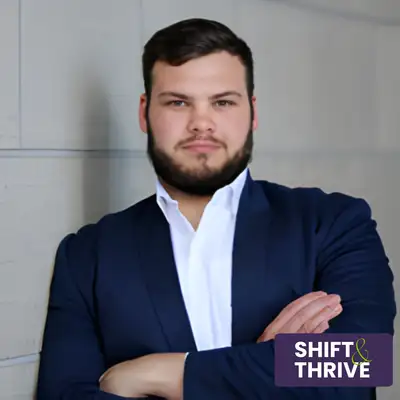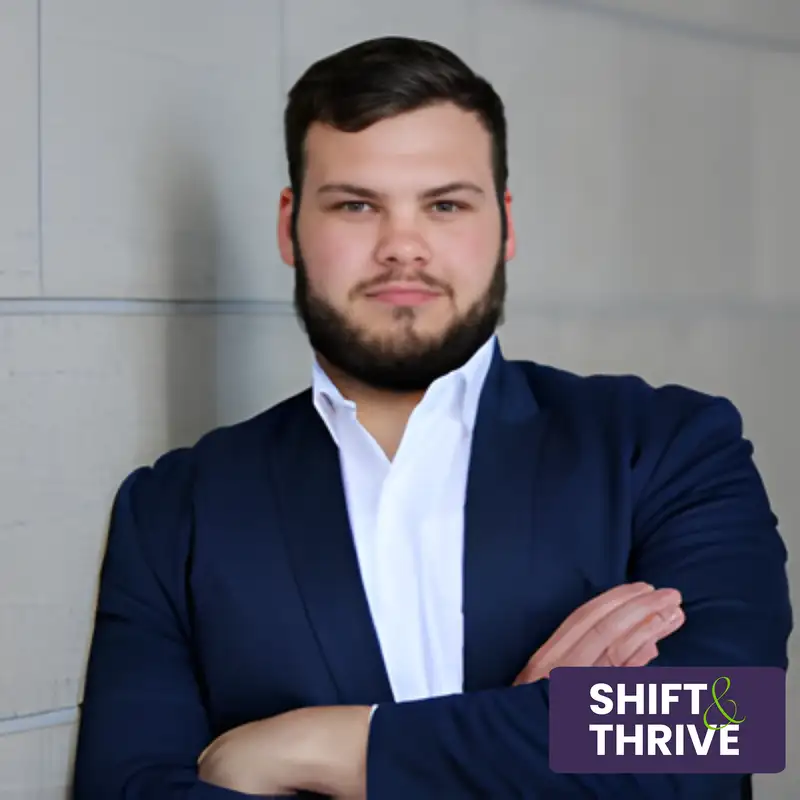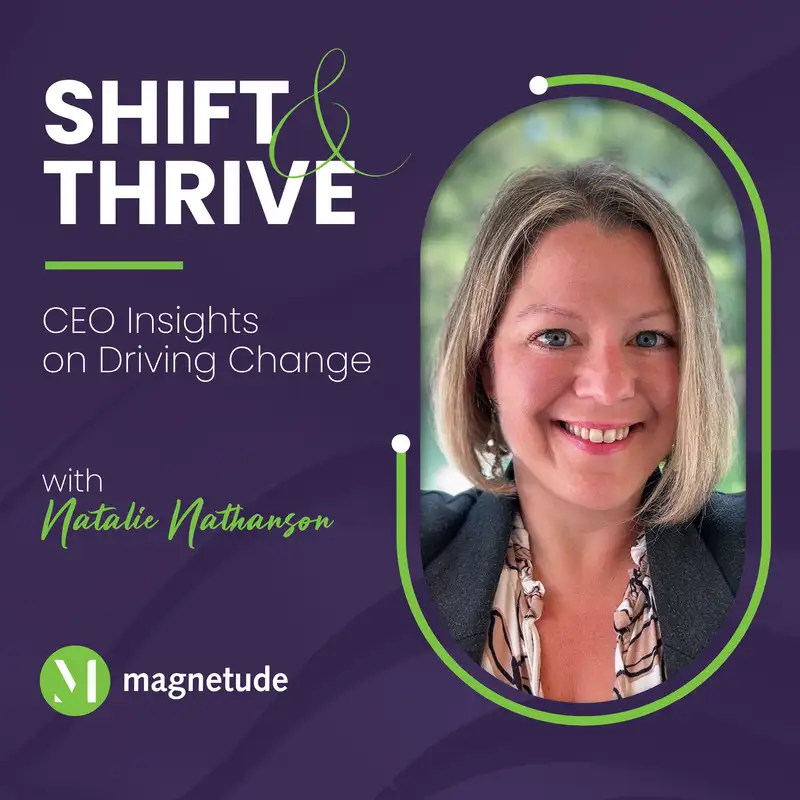
Reinventing the Business - Sam Ziman - Shift & Thrive - Episode # 089
S&T_Sam Ziman
===
[00:00:00] In today's business world, change is the only constant, and mastering transformation is the ultimate key to success. Welcome to Shift and Thrive. I'm your host, Natalie Nathanson.
Each week we'll bring you conversations with CEOs who delve into how they successfully drove critical change in their organization. This show is sponsored by Magnitude Consulting, bringing you the thinking power of a growth consult. And the getting it done, power of a full service B2B marketing agency.
Natalie Nathanson: I am very excited to introduce today's guest. He
is a data scientist turned operator who has led multiple
full scale company transformations in just a few short years since stepping into the CEO role in his current company, he's a growth focused leader who helped evolve his organization from staffing to manage services, and then from services to
SaaS
product.
Within
his first two
years [00:01:00] of joining the company, he helped them win
their first three Federal Prime contracts, and he's now leading a strategic initiative into the commercial healthcare
market.
He's someone who believes opportunity favors the prepared, and that sometimes the most important deals happen outside the boardroom.
He is
the CEO of Global Commerce and
information,
also known as Global Ci
SAML
Zeman, welcome to the show.
Sam Ziman: Hi, Natalie. Thank you so much for
having me. Looking
forward to
talking with you.
Natalie Nathanson: Thank you. I am as well. And I know as I mentioned in your introduction, that you have led multiple, uh, reinventions
of your company
in a
relatively,
uh, short period
of time, and that one of the most significant ones
was moving
from
kinda services based model
to building SaaS products.
And I know very well, uh, You know, how, how big the, the implications are, uh, for that, for an
organization. So I'd
love to unpack that with you and, uh, really starting by having you taking us back to the moment of, You know, what prompted the move. Can you
talk about that [00:02:00] first and then we we'd love to dive in
deeper.
Sam Ziman: Absolutely. So when I joined the company, uh, six years ago, we were a staffing firm, uh,
for the federal government essentially, that
that was where our focus was.
And the real question was, are we resilient? Right? We were winning work. uh, As subcontractors,
but were we building something durable or were
we just
busy?
So what happened? Uh, what happens if,
You know, let's
say a new,
um, political initiative
starts changing work in the federal
government, right? Like we're
all seeing now.
Uh, and I always
say it's sometimes it's better to be lucky than good. Uh, didn't see anything coming, but we were worried about resiliency.
Uh, hyper-focused in one area, You know, one specialty
and, and not spread across many agencies.
So
we started
looking at
what could we do next, [00:03:00] right? What could we really build with all the experience and the people that worked within this
company? And, uh, we found a, a lot,
a lot of
opportunity. So that's what led us
to
win those prime contracts, was telling, uh, You know, telling our story as a service provider, not as a staffing firm.
And how do
all those,
and
how did all those
hours
Of working in the
federal government translate to us being able to do the work ourselves? And, uh, telling that story was definitely a learning curve for everyone, but it, it ended up going really well for us.
Natalie Nathanson: That's great. ~What would you say are some of the biggest shifts that,~
~uh, had~
~to take place in the organization?~
Sam Ziman: ~We had to get everyone on the same page.~
~Um, when you're a staffing firm, I think it's really easy to forget who your~
~employer is,~
~right? You come~
~on and you join~
~through the staffing agency,~
~but you end up working for Company~
~X,~
~and that kind of~
~becomes more~
~your identity than the staffing~
~firm.~
~But When you're a service provider and you're still providing~
~services to Company~
~X, You know, the company that you're working through should be your identity.~
~creating that buy-in with a lot of the employees that we already~
~had, understanding that we were changing our mindset about how we went into things and how we wanted them to change their mindset. And You~
~know, part of it was. Giving them a chance to contribute to~
~what this company looked~
~like. Right?~
~You know, staffing firms~
~don't necessarily need or do that.~
~They're providing a, You know, basic service.~
~So when we changed that,~
~we started talking~
~to them about,~
~Hey, what~
~do you think~
~we~
~could do really well? You~
~know, what, what~
~are you amazing at? What would you love to do? And we'll go hunt for these things and find you the project that hopefully is you're passionate about.~
~And. You~
~know, once we had that~
~conversation, things started moving.~
Natalie Nathanson: and then I know more recently you've made the, or are made or are making the transition from services to SaaS products. Can you talk about. Out. You know what
initially prompted that?
Sam Ziman: Yeah, so same thing. Are we resilient? Right? What, what's gonna happen if uh, everything hits the fan? What's global CI gonna
do?
And then we started
doing the services. So then in the [00:04:00] services discussion, we're talking to people and they say,
oh, we built
this
and we built that.
And I'm like, You know, this stuff's
really amazing.
It's amazing on, on, on
a scale, You know, far outside of where it is with a lot of value to a lot of people.
And since one of our main missions is always to just help
people be better and be better ourselves
while providing
something that
has much greater value than its cost. We found some products
that we had
essentially developed,
um, in, in those environments, and we decided to take
them commercial. And, and that was really,
that was really a learning curve, right? Um, switching from,
uh, hyper transactional
company to a product firm, which is, You
know. You eat what you kill versus plant and harvest.
Right?
Um,
and that, [00:05:00] that mindset took
sharing a lot of the vision with everyone. What do we see this company in five years, 10 years? Um, and how
do we justify, You know, all
these investments
into this product to where
there isn't anyone paying for it at first?
Right? I mean,
that's the route we ended up taking.
Um.
Natalie Nathanson: And
Were these, uh, products
that were initially
developed, like
for specific customer use cases, and that's where kinda the, the ideas came from to make it, uh. Kind of more commercially available, more broadly.
Sam Ziman: Yeah. Initially we were building them in, in a federal agency and we
saw
that,
that the location
of the product
sitting in the federal agency might not have been the
best
place for it.
Right. They were, you kind of end up
at the end of
a process
versus at the beginning
of a problem. Right.
And what
we really wanted
to do was get
out front
and how can we help it, You know, and,
and [00:06:00] go and help
the people
that need this product and then essentially relieve a lot
of stress
off of the federal agency itself.
You know, it doesn't in any
way diminish the function of
that agency or
what it was doing. Um,
if anything, it makes
it more critical.
But if we can
get out
front of that
problem. We could streamline
the whole
process, that by the time it got to them,
they were
really getting, You know, more polished data information
and a, and a
product that they could consume easier and move along easier.
Um,
and just put
less constraint on, on already constrained resources.
So it moved the whole thing
to be very seamless.
Uh, it helped people helped get them
coverage.
And returned a lot of value
to our healthcare
clients 'cause we focus, uh, with
hospitals mostly. And that's one of them. And then the other product was, You know, the growth sector.
Uh,
one of the
people that
works with us is
a former hospital, CIO, and he just saw a
ton of value [00:07:00] in helping people identify the market that they work in and
the services they provide and
whether or not they were doing the right thing at all.
He sat through however many meetings in hospitals and he said, You know, I, I think we're
doing it wrong.
Um, and when he eventually left and came to us, he wanted to set it right and he
wanted to help change
and, and evolve those visions for the leaders of those organizations to get them
on the right track. You know,
if,
if you already have, if money's getting
tight.
You have hospitals across the country, You know, closing in
record numbers.
Each decision
is critical.
So how do we
show them and help them understand the world
they're in better so that they can make better decisions?
Natalie Nathanson: I'm curious to learn a little bit more about kinda some of those changes that had
to
take place, because I know from
the number of
clients that we've worked with that
have made that transition, right, there's[00:08:00]
cultural shifts for kind
of the team
to think differently. Um, there's obviously more flexibility in services than there
is in. In SAS products,
right?
Where services you can kind.
More and kind of shape around the, the offering around
kinda the needs
of an individual client and the SaaS. I know more of, uh, that
work has to be done
upfront. Um, so curious to hear from you, like what were those big areas that, uh, that needed to look different as, as you've been going through this?
Sam Ziman: So we're, we're super lean, right? Buy, buy-in
is critical. Um, everyone is a decision maker in
a small business. They all, everyone works in sales.
Uh, everyone is hands-on, right? And we
all have tons of hats. So when I worked at Medtronic uh, as an analyst there for a while, I'm gonna leave the guy's name out because I
can't remember what his last name was, but he had this idea, um.
that
[00:09:00] he learned and he
shared with us
called radical transparency. It's not a, a new idea and, and even though it's called radical transparency, it's not a radical idea by any means, but
It really resonated with me because, especially
at larger companies
like Medtronic, where, You
know, it's a $32 billion company
and there's so many
moving parts.
you don't always understand what's happening or why they're doing
something, and it may
seem nonsensical to you when you're, You know, boots on the ground.
But through that program we got to see a much larger picture
that was easier for us to
consume and just. to,
execute on it and
make sure that the decisions we were making aligned with that.
So I really
liked that.
And You know, I took it even one step further to just be completely transparent with everyone
at my company that's a contributor.
Hey,
this is really what we want to do. We think this is the right thing,[00:10:00]
but we need to understand, You know,
you're the SME. Am I, am I off base? Did
I
miss the mark?
how can I get back on, how can You know
we change
entirely.
to entirely
is exactly how we changed, moving from staffing to product,
and what
do we need to bring on? And it's always a
relief when so many of the
people you work with have ideas
and have knowledge that they maybe weren't necessarily utilizing at that
time.
But that translated really well
over here.
they shared that journey
with us and what
we, they
thought we
needed to do.
and just showing
them where
we were trying to
go made it easier to steer the ship. It was just
more
hands on deck,
made less work for everyone and, and we were
able to move it and
the
communication across
the entire company
all the time.
And that's
really part of it all the time, talking daily, [00:11:00] especially when you're fully
remote, because, uh, they,
there was a study not
long ago that said, uh, someone 50 feet away from you.
has
the same rate of communication with
you as someone in
another state. It really only took
50 feet of separation to put
everything remote.
Um,
and You know, when COVID hit, everybody went
fully remote. We got rid of our
offices. Most of our
people were on site
with clients when they needed
to be anyway. So making sure that in that remote environment, that communication didn't break down, didn't lapse.
Um, and just stayed in front of people all the time, whether you were texting a group chat, um, hitting 'em all
up
on teams, creating
recurring meetings, just to check in,
whatever it was. Just making sure everybody
knew that we were
all available and if they had something on their mind,
they could reach out to us or because we had multiple touch points, they could just hold it
for that.
Whatever was
more convenient and that really helped us
[00:12:00] stay on top
of everything.
Just talking all the time and not letting
that communication break down.
Natalie Nathanson: I think that's a, a sign
of a, of a strong culture and a dedicated
team.
And I know, You know, especially, You know, in times of change, which we talked about COVID, we know now like organizations are going through tremendous, uh, change and evolution with kinda AI and, and all of that. Um, and I'm curious to hear, uh, if there were any kind of examples of anything that came up from, from the team, any kinda surprises or anything that, uh, kind of pivoted or
shifted your,
your direction,
uh, based
on something you heard from
the
team?
Sam Ziman: Absolutely. What's the point of having subject matter experts if
you don't listen to them? Right?
Um,
I
learned everything is done. It
took a lot longer than I hoped or thought.
when you're,
I think
I'm more of a dreamer than anything else. So sometimes I really,
I'm, I'm sprinting in
my head,[00:13:00]
uh, due
to a lack of
understanding of what it's
gonna take to get where we need to be.
And I'm already ready for phase two.
You know,
I, I visioned phase one.
I gave
it
to you guys. Alright, when's phase two?
And I had to listen
and
slow down and understand
the lift. And what it was gonna take and what the people needed to get it done and made
sure that before anything else
that was provided
for them,
right?
You know that servant
leadership is really powerful. If your people are
tired, go get 'em. Coffee. That
title doesn't mean anything. If, if you drive it into the ground,
you
did nothing. So listen to your people. It, it, they, they know. They're in it way, way more than you are.
Um, especially, You know,
I'm 35, so
my
company is just full of people with tons of experience
and I just need
to hear what they [00:14:00] have to say so that I don't get, You know,
what
I think is,
You
know, right around the corner
is actually two years down the road.
Um, and that was a, that was
a pretty good lesson to
learn.
Natalie Nathanson: Yeah. I think you raise an interesting dynamic
too,
where as a leader, right, you need to
be thinking
a few steps ahead, right? And like you said,
the, the product and kind of thinking of the phase two, uh, but also like very much grounded in the present reality of the organization and not kinda running ahead when your team is still
focused on delivering what they need to deliver every day and kind of working through the change and, and all of that.
So sometimes easier said than done,
Sam Ziman: Yeah. And, uh, and not
creating undue stress on them. because you, you're so far ahead in your mind that,
and
they have to be like, Hey man,
relax. We got a lot of work to do before we get there. Um,
and just
being receptive to that. But
you still still need a dreamer and you need a doer.
You need, you need all those
things to work together [00:15:00] to, to get
where you're
going.
Natalie Nathanson: Yeah. Yeah,
for sure.
And You know, you're talking about, You know, you alluded to your servant leadership style.
I love the radical transparency that you brought in. Would love to hear just how you do, describe your leadership style.
Sam Ziman: no. No matter how many times I
hear that question, um,
I don't know if I've ever had a great
answer. I think it's. Something better for someone else to answer. But I'll tell you what my goal is.
Natalie Nathanson: Perfect.
Sam Ziman: My goal, my goal is
to
almost be invisible. there's a saying by
lousy that says
when
the work is done
and
the dream fulfilled, but people will say, we did it ourselves.
And
I think that
that is probably
the most
important thing
that I hope to be as a leader, is
someone that gets everyone where they're going
and, [00:16:00] and they 100% know that it was their time and
energy
and effort that got us there.
Natalie Nathanson: I think
that's really beautiful. I,
uh, I
share that kind of a view. You point. And
I think
it's very
important to, for
the team to have pride in,
You
know, what they're doing day to day, what they're
building.
Um,
so I think that says a lot about you as
a person. Uh, I'm curious
if your leadership style
has changed over
the years.
Sam Ziman: Uh,
yeah. Yes. Um,
I, I, so even though I did
go into data science
before that, I
was a bicycle mechanic.
For a
long time and I had a lot of fun doing that. It was excellent. Um, I think everyone should work in
some
kind
of services industry growing up 'cause it helps you, uh, be grateful to the people around you and all the people that,
uh, end up.
You know, serving you at some point, whether it's a restaurant, [00:17:00] your car, something like that.
Just go see that point of view. Walk a mile and some shoes.
Uh, I walked many miles and then even though I had
no idea what I was doing
when I
graduated
college, I really thought I did. And so then,
um, I walked around for about a whole year with my foot in my mouth.
And
there's lots
of, uh, embarrassing haunting stories that
I have from that
that, uh, sometimes keep
me awake at night for no reason. But really it's about, You know, learning that lesson,
uh, not wallowing in it or
becoming mired in some of those things. And, uh, making sure you don't do it twice.
Hey, this is Natalie, your Shift and Thrive host. After chatting with lots of CEOs, one thing is crystal clear. Leveling up your company means having a killer Go-to-market strategy. That's what my crew at Magnitude Consulting does every day. If you're trying to step up your [00:18:00] marketing game, whether it's strategizing, accelerating your pipeline, expanding into new markets, or getting into AI and automation, let's talk.
No pitch, no pressure. Just good conversation. Visit shift and thrive podcast.com/natalie to schedule a time. Can't wait to connect.
Natalie Nathanson: ~I'm curious to ask how you went from being~
~a bicycle~
~mechanic into data science, and were there other~
~steps along that journey or, You know, how did,~
~how~
~did you get to~
~start the career you're, you're in today?~
Sam Ziman: ~Well, I think it's a pretty generic tale, but I went to school for a long time, changed~
~my major a whole bunch, and kept restarting that,~
~Uh,~
~collegiate~
~career. I ended up in Colorado,~
~went to their school of~
~business.~
~something clicked. I don't know if it was because~
~I was a little~
~bit older or I'd~
~been doing it for so long, but,~
~um,~
~it,~
~it definitely made sense when I was there for some reason, when I wasn't in anywhere else, followed that path.~
~You know,~
~the school offered an amazing internship~
~programs and opportunities that were exclusive~
~to people in the business~
~school. Took advantage of that.~
~And then, uh,~
~yeah, some~
~unfortunate company took~
~me as their intern~
~for the first year and, um, I was probably much older than they expected me to be~
~when I got~
~there and, uh,~
~just cut my teeth~
~on 'em real hard.~
~It~
~was,~
~it was~
~a lot of learning and then~
~normal stuff, right?~
~Um. Started doing some data analytics, working with the data team. Hey, I really like this. What could I do with this~
~more? Next~
~job, full data focus forecast analyst for CenturyLink.~
~Next job, um, data scientists and sales analysts for~
~Medtronic.~
Natalie Nathanson: ~And the rest is history.~
Sam Ziman: ~Yep.~
Natalie Nathanson: ~Um, yeah. I also love what you said about right. Everyone should~
~work in a,~
~in a consumer~
~services industry. Um,~
~you made me think about, uh, my college days, uh, working in restaurants as a hostess and then wait staff. And, You know, first off it~
~was just so fun~
~and~
~I was very energized~
~by~
~kind of the~
~multitasking and what do I need to,~
~can I grab from this part and go over to~
~that table and.~
~Um, but it also like gives you thicker~
~skin, right? Not everyone is nice. Not~
~every moment, uh, you kind of feel at your best. Um, so I think of, uh, just the impact that, that had, uh, eventually~
~going into sales, right?~
~Where~
~not. Everybody responds And~
~so I~
~think~
~all of these experiences do, do really shape us.~
Sam Ziman: ~Absolute.~
Natalie Nathanson: I am, uh. Curious to follow up on, on something, uh, that you said, uh, when we spoke previously, um, right, that success is, You know,
when preparation meets opportunity, uh, because
I know a lot of your biggest wins, uh, didn't come through kind of more traditional. Uh, structure
or sales processes, but kind of being at the, the right place at the right time, so to speak.
Um, but I think that's also, um, which says something about you. So I'm curious, like, how do you think about this? How do you position, uh, yourself, uh, so that these opportunities, uh, so you're kind
of opening the door for these opportunities?
Sam Ziman: Mm. I think, uh, one of the sayings
that I, I love
and when I need to
change.
something I'm
doing [00:19:00] is you become what you
study if
you want to be a car mechanic, you need to
live and breathe
and read and write
and study, and watch and consume
as much as possible. It will
saturate your way of thinking so
that it becomes a second language.
~ when it, I~
~gotta~
~stop~
~saying~
~that. ~when
we
move to services, I
started learning and thinking like a services
company. Reading
a case studies, case studies are such a huge help. people have already learned the lesson for you. You don't have to learn it the hard way. You,
you're probably gonna
learn it no matter what,
Um, and you're gonna feel
that
disappointment. But if you understand where you
went wrong, then you don't have to learn it over and over and
over again. So, become what you study, study what you need to be.
You know, we're going into products.
I,
it has been like drinking through a hose, learning
the lingo.
the more [00:20:00] specific your product
gets, like a lot of ours are, and the
more you work in
the industry, you have to learn your industry.
So you
read the news about healthcare and hospitals and
you just keep learning
about it. What makes them tick? What should make you tick?
What should your product be hitting on that's gonna
bring value to these people?
You know, if You know something that keeps somebody
up at night
and you have
a solution, that's what you need and you need to speak their language.
Natalie Nathanson: I'm curious, what, what do these learning practices work best for you? Are there certain kinda rhythms
or types of sources that,
that, you find most beneficial?
Sam Ziman: I, love to read. I love to read. So find a book. About what you do
find and read the
reviews, find an entertaining book because it's, there's gonna
be a,
a lot of
brain drain,
uh, before
you even get the message as you learn the lingo.
Right? That's a big part of
it. So,
um, [00:21:00] I actually have one,
I don't wanna advertise someone else's stuff, but when we started get into federal contracting, Dan Roche wrote a book, uh, called The Total Beginner's Handbook for Doing Business with the Gov Government.
You know,
basically,
um, working with the government for
Dummies,
It's amazing and it outlines what you
need to do.
And then when we started to go through transformation, I just have
these all right here.
This is not a pre-setup,
I swear. Um, one of the other ones was,
uh, the Outliers, right? This is
basically case studies by Warren Buffett and what made different
companies different. They're not all relatable by any means, but
The language
in there is
amazing,
and the stories are really good and the writing makes
it enjoyable. So, You know, you start picking
up books that are what you need to
be and learning about them and seeing what other people have already gone
through [00:22:00] and taking those lessons with you.
Mm-hmm.
Natalie Nathanson: Yeah, I love that. Uh, You know, Patrick Lencioni is one of my favorite, uh, business authors, and
it's for the same reason,
right? He writes.
Them as stories, so you're not reading kind of a, a dense textbook, but, uh,
you're really kind
of learning through that,
which is that, that case study approach.
I'm curious, You know, how much of this is, uh, just you versus others in your organization, and are you, have you
tried, like, is to instill
this kind of mindset, uh, in others on your team, or do you kind of let let people, uh, You know, do it on their own
or
not?
Sam Ziman: It is definitely a mix. different people move at different paces you have to make room for all of them.
especially at a lean company.
they're all pivotal. But
You
know, being a 30 5-year-old CEO,
you need to sit and listen to people that have been
doing this twice as long as you have, and you need to listen,
and your ego [00:23:00] needs to go.
in the trash.
You gotta get rid of it.
Otherwise,
you're never gonna hear what
they're saying.
And You always need to listen with the intent to hear, not to respond, and sometimes that's a conversation I have
to have with
my more technical people.
Um,
they just
tend to
get really into the detail and the conversation can get, uh,
really pulled
apart and away from the target of the conversation.
it's because the, the, they get way far down the line with the solution. Um,
past the point where they're necessarily
hearing the, they're not
quite
hearing the problem the same. And sometimes we, You know, and on the other side of that, I might not be right. If I don't understand the solution enough, I might also miss
it. So the truth of of that
is in the middle is where we need to be, far enough down the line where we're talking about the solution[00:24:00]
and right on track with where
we need to
get to the goal. So
it,
it's all about that open communication. Nothing is all of,
of one thing,
especially not at
my company.
Um, it's definitely a culmination of everybody's
personality and experiences and
knowhow and all of us working together to find the best way forward.
Natalie Nathanson: I think too, um, You know, you're talking about kind of listening
to truly hear
versus. Kind of preparing your response, which I know can, can be tough.
I think thinking about like,
like meeting note takers and
kind of using generative ai, I think opens up a lot new, a lot of new
opportunities to do that.
I know sometimes for
me, like hearing a conversation that I was a part of gives
me kind of a different lens through
it or
putting it into kind of our corporate LLM
and then,
Hey, what did I, what did I miss? What did I not ask that I
should have?
So, it's interesting to kinda have that, uh, You know, sparring [00:25:00] partner, so to speak,
like with
yourself or like through technology, that
that
can really help open up our minds and look in
different directions like that.
Sam Ziman: ~Being able to listen and not have to create like a whole new version~
~of shorthand writing to keep up with a conversation~
~that's moving~
~really fast and~
~then hoping~
~that when you go back~
~and look at your notes,~
~you understand 80% of it.~
~Uh, and just being able~
~to be present and part of the conversation and not~
~have to worry~
~about all those backend action items because they're being captured.~
~That's great. ~
Natalie Nathanson: I wanna hear a, a bit more about your company and, You know, we're talked about some of your company's transformations, but what kind of transformations are,
are your
customers going through?
Sam Ziman: Absolutely. So the federal government is going through a lot
right now.
Um,
a lot of hardship, uh, empty
offices, same amount of work, fewer people. Uh, less resources to
get the
work done. Tons of stress and a lot of pressure.
Everybody's
watching you. Everything that happens directly affects us.
That
was one of the things that made me most proud about doing federal government work, is everything we delivered
to
the federal government, they turned around and delivered
to 400
million people.
And that was
really,
You
[00:26:00] know, what, what better calling can you have than to.
help the people,
helping the people.
But that same mindset transitioned for us when we moved over to
hospitals.
It's about helping the people, helping the people. And, You know,
sometimes the pillars in our lives themselves need that assistance to stand up and, uh, on their own two feet in a lot of ways, and be prepared and feel
that working with you as a company
is strengthening their
position,
uh, everywhere.
And That,
You know, part
of it is not
trying to be
diplomatic here, but
You don't have
to live
in
a customer forever.
They have
a need. You might
just be passing
through.
So show
up, deliver, and if
there's no
longer a need, don't create [00:27:00] one. Don't just sit there and, and drain
the resources.
Get them to where they need to be and move on.
They will remember you for that.
They will come back to you just to
see if you can do a thing,
because you did it,
you got it done,
and you didn't
hang around to
see if there was, You know, some crumbs left over. Or if you could do
something that someone else was doing well and, uh.
You know, that's not necessarily in line with a
lot of the competitive business thinking
that might exist out there
today, but I think it's
highly valuable to be
able to come and execute.
and
relieve stress and not
be a burden
for
your customers.
Natalie Nathanson: I couldn't
agree more.
Uh, You know, we have something similar
on my marketing consultancy where really
the focus is staying as long as you bring
value. And recognizing that some of our best client engagements, we successfully
worked our way out of a job,
right? We worked
together from the, the origins of [00:28:00] putting their, their marketing.
Strategy
and infrastructure in
place, uh, executing, uh,
in some cases, uh, helping to,
to kinda build and grow the team, and then getting them to a point where they're self-sufficient, right? Every, every client is different as far as kinda what they need
and, and for
how long. Um, but to your point like that, that's what builds trust.
That's what
fosters,
uh, the right relationships. And at the end of the day. Uh, all of this is about, is about relationships and right. If you make your clients successful and they remember you fondly, that that does come, come back around. Uh, not to mention it, it
just feels better, right? Living as a,
with, with those
kind of values,
Uh, so we've talked about
some of the, uh, transformations on the, on the business side. Uh,
I'd love
to kinda zoom out and
like
hear a little bit more about you personally. Um, so would love to start by asking you, You know, who was SAML as a child and how, how did that reflect, uh, kinda the career you've
ultimately
built
for
[00:29:00] yourself?
Sam Ziman: I'd say I, I was a
rascal. Um, I still
am.
Uh, a social butterfly.
I really like to be out
and about
and, uh, don't like spending too much time alone.
So, You know, being in, in these roles, uh,
maybe the open communication
thing with my
company is more for me than anyone else, and I just need to talk to people all the time, every
day, and I love it.
Um, but.
I
played sports my whole life. I still play sports. Uh, I'm still very competitive. I still go
out and compete and
I think that
helps a lot
to feed that
nature and to bring it
to the workplace and try to put and instill
not a sense of
urgency, but a,
a fund competition. And not within
the company, but with
your.
Competitors with [00:30:00] people
that are out there,
you want to beat them to the punch. We got something new. Is anybody
else doing this? No, let's be first.
Let's get there. Let's get there
fast. Um,
and that's me not learning the lesson. I talked
about learning earlier. Uh,
that sometimes you gotta slow
down, but
going
slow is tough.
And I think I was like that as a
kid too.
Um.
Natalie Nathanson: Any
stories come to mind
to share? Either, uh, You know about. It called yourself a rascal. Uh, anything you've learned from, uh, from
some of those as a, as a, as a kid?
Sam Ziman: I think one lesson I
learned, um, and, and a former boss
of mine taught me. He put it in. He didn't say it to me directly
to shape the story a little bit differently, but it
was in the employee handbook
and
it said, never miss an opportunity to shut your mouth.
'cause there is going to be
one, and if you miss it,
you might be
[00:31:00] missing a lot more than that opportunity.
You might be missing something important that needed to
be said,
but you talked through it or. You didn't quite understand something and didn't realize it, and
now
you've changed someone's perception of you
or you've really, really
put your foot in your
mouth and
I've eaten a lot of shoes. So that's,
that's a lesson that is not fun
to learn, but down the line
when you have something to
say.
You're not sure if it's right and you don't say it,
and you, on the
other side of the conversation, you
catch
everything
that you realize you missed, or that you were gonna be wrong about. Man, that feels like a powerful
lesson, that feels like very transformative
sometimes to, uh, just not say anything
and
listen.
Natalie Nathanson: I love that, and I think that's, uh, good advice for, uh, for a lot of folks to, to
think through.
[00:32:00] Um, so I know we're nearing the end of our time, but as we
wrap up today's conversation,
can you let our listeners know
what's the best way to get in touch?
Sam Ziman: Yeah,
so, uh, SAML dot ziman@globalci.com. If
you want to email me, you can go to my LinkedIn, which will be provided in the bio, and my work number and
email are on there as well.
Send me an invite.
Let's connect. Let's talk.
Natalie Nathanson: Wonderful. Wonderful.
Well, thank you. I really enjoyed talking with you and
talking about, uh,
what has shaped, uh, and informed your leadership style, uh, and the different transition. that you've
helped lead your organization through. So thank you so much for sharing that.
Sam Ziman: Great. Thank you so much, Natalie. I really enjoyed our time.
Natalie Nathanson: Uh, same, same. And thank you to, to everyone that's listening, and
if today's conversation sparked something for you, please pass
this along
to another leader. Because we know that insights like this
really
fuel fresh thinking for all of us
and help us drive real change in our company and in ourselves. So thanks [00:33:00] again, SAML, and this has been another wonderful conversation on Shift and Thrive.
I'll see you all next time.
That's a wrap for this week's episode. For show notes and more visit Shift and thrive podcast.com. A special thank you to our sponsor, magnitude Consulting, bringing you the thinking power of a growth consultancy and the getting it done Power of a full service marketing agency to help B2B companies fuel their growth.
For more information on magnitude and to get your complimentary transformation readiness assessment, visit magnitude consulting.com/. Get ready. Thank you so much for listening. We'll see you next week.
Creators and Guests