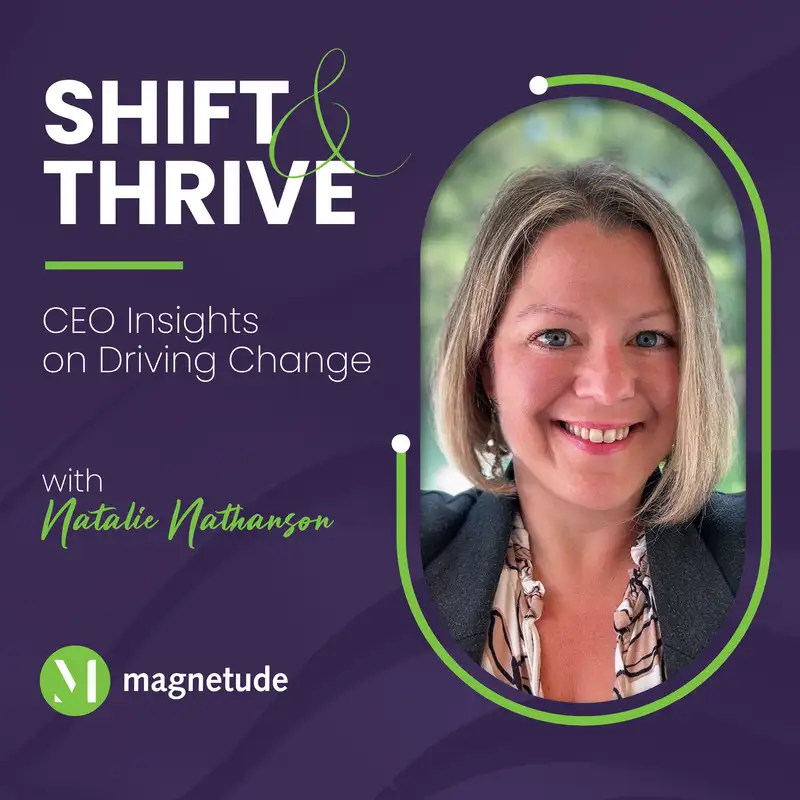
Flipping the Mic on Natalie Nathanson - Shift & Thrive (Re-air)
S&T - Flip the Mic
===
[00:00:00]
Natalie: Today's episode is a little different than usual, and it's going to be a special one.~ We're kicking off season two of the podcast and celebrating our first full year of inspiring conversations with CEOs and other executives around how they successfully navigate today's complex and rapidly changing landscape.~
~So to commemorate the milestone, we thought it was the perfect time to try something new and flip the mic. In other words,~ today's guest is going to be me.
I will be stepping out of the host seat and into the hot seat to share more about my own journey and dive into some of the lessons that I've learned around leadership.
Go to market strategy and driving innovation and transformation within my own organization. And I [00:01:00] couldn't think of anyone better to guide today's conversation than the woman I'm about to introduce. We've been
working together
for over 12 years. She joined Magnitude Consulting as my second full-time hire back in 2013.
Uh, just around year one of launching the business and has played a pivotal role in the business ever since. She's an award-winning marketing strategist, including a two-time winner of the cybersecurity marketer of the
Year, and the brains
behind some of our most creative and impactful campaigns and go to market strategies for clients.
She's a key member of my leadership team and a valued colleague and friend. She's magnitude's, VP of client Strategy and delivery. So today's host I'd like to introduce is my colleague, Cindy Hunter. Welcome to the show and thank you for leading us in today's episode.
Cyndy: Thank you, Natalie. I, I can't believe I get to put my boss on the hot speed hot seat, so I'm excited for this.
Natalie: I am
too, a little nervous. We'll see
what you put in front of
Cyndy: We'll see.
[00:02:00] Um,
so I mean, I
wanna introduce
you too because, you know, I know you do the podcast all the time, but you hardly ever get to say,
you know, what's
so great about you and this is about you. Um, so Natalie is a marketing powerhouse. She's over 20 years in B2B.
She's part strategist and part sales whisperer, in case she didn't know that. Um, she's a former Forester marketing guru.
Um, and
she turned founder and CEO of Magnitude Consulting, which we'll talk
a little
bit about, uh, where she helps tech firms B2B firms scale with smart. Fractional marketing.
She's
worked in cyber ai, SaaS, big data, like the list goes on and on, products and services.
If it's B2B and technical, she's helped companies grow countless. Times. Uh, she's a regular contributor on Forbes, um, and public Service Announcement. If you [00:03:00] haven't checked it out, you should. Um, it's not just marketing speak that
she talks
about. It's really actionable insights designed to help
businesses grow.
So really go check that out as well. Um, and as, as you know, like one year in, she's the regular host of this Shift and Thrive podcast, and it really digs into how CEOs have an impact, um, go to market transformations and. tells a little bit about their personal stories too. Um, so thrilled to kind of flip the script on Natalie and, uh, pick her Amazing Brain and I'm excited to kind of move
through some
of these questions.
You ready? Na,
Natalie: I'm ready. I'm ready. Thank you.
GMT20250611-170603_Recording_1280x720: Great.
Cyndy: Um,
so let's go into the way back machine,
uh,
over a decade ago. And I was there alongside you. You founded Magnitude. So tell us about that journey. Um, you know, your go to market approach for the firm when you were just getting [00:04:00] started.
Natalie: So the, the idea for magnitude really came after having spent the first part
of my career and kind
of, I'd say the majority of my career prior to starting magnitude and in-house marketing roles, uh, often. At Resource Constrained Companies. So I've been kind of the first marketing hire at a startup. I was on a marketing team of three and really saw a gap between what startups needed to do to be successful and what, um, you know, the realities of being in a startup with resource constraints and only having the skill sets of the number of marketers you have on the team.
Um, and so really saw an opportunity to do marketing differently. Um, some of that was also influenced by my time at Forrester Research where we had a, you know, around 30 people in the marketing organization and really being able to see, um, what kind of marketing looks like when you do have all those experts coming together, which is not the luxury in the smaller company environments.
And so
magnitude was really designed, uh, to become a different kind of marketing firm, and one that [00:05:00] blended, uh, both marketing, leadership and the strategic focuses of marketing as kind of a growth enabler to the business. And then also having full service execution such that you can have kind of the best of breed on the execution side and the strategy working hand in hand, which, you know, for startups, um, they need, they need both and they need it back and forth and, and very fluidly.
Cyndy: there's no unicorn marketing person, I don't think anymore for
Natalie: No. No. And I would say like, even
more since I know since uh, magnitude was started, uh, marketing became more and more specialized, the competitive landscape became kind of stronger, uh, and kind of more challenging. And so that need to, um, really fire on all cylinders and, you know, do it the right way, um, I would say is only underscored.
And I'm sure you and I are gonna talk about that
as we go through the conversation,
Cyndy: right. Were there guiding principles or areas you kind of rallied around initially? Or can you talk a
little bit
about [00:06:00] that? I.
Natalie: Yeah. Yeah. And the interesting thing, like I mentioned, the initial focus was really on startups. I think one thing we found, uh, over, you know, the first few years in particular.
was it the same
things that we were doing for startups? Uh, we started getting, uh, interest and demand from larger companies that were, you know, going through, uh, changes, uh, their own kind of business transformations and, and things of that nature, uh, because they needed that kind of full view into the strategy, the execution, all the different areas of specialization.
Um,
but I would say, you know, as it relates to, um, kind of our, our model, there's maybe three pillars that I'll talk
about. Um, one
was really,
you know,
our delivery model, uh, in and of itself as something unique we were building. Um, second was really our industry
focus. Uh, and
kind of building up that industry expertise.
Uh, and then third is, you know, I like to say we drink our own Kool-Aid. Uh, and so the investments that we've made in our own, uh, sales and marketing efforts and, you know, we [00:07:00] can certainly delve in deeper into any of those.
Cyndy: Yeah. I mean, in terms of the industry expertise, like, is that really
important? Um,
Do you think it's important and I know what a clients think, so um, just, just
from the outside, like
some
people say doesn't
matter, it's all the same. So could you just talk a little bit about that?
Natalie: Yeah, yeah, definitely. And I would say, you know, there are some differences
depending on your
environment. A good marketer can learn kind of a new space. Um, but as a service provider, uh, especially working with often resource constrained businesses, you wanna make sure that you're delivering value quickly, um, and having an impact.
And I think having that impact is where you really need that industry. Expertise so that you know, the target market that your clients are selling into, you know, the pain points that they're facing, uh, you understand the ecosystem that they're in because, uh, kind of the, the,
service provider,
like partnership type landscape.
Um, and [00:08:00] especially I would say for a lot of the types of audiences that we sell to, it's,
you know,
technical, uh, leaders, executives, it's audiences that are notoriously, uh, apprehensive of being marketed and sold
to.
Right? So they can. Yeah. Yeah. So you, you have to like, have your marketing, any kind of messaging and content, be very authentic and speak to that audience.
So I think, you know, all of those areas have really, um. Underscored kinda the importance of knowing that audience. Um, but I'd say a little bit of a, a balance, right? So we've always been under that like B2B Tech umbrella as far as the types of clients we serve. Um, we now do have some clients in other industries, uh, or some kind of very successful engagements, um, but have also very much stayed true to the expertise that we've built in cybersecurity and IT services.
And so that's. Uh, you know, with, with your help, always having that right balance on the team of the industry experts and the kind of functional domain experts
as well.
Cyndy: Right, right. And [00:09:00] it's, it's really neat to learn new industries too, and then make the connections,
GMT20250611-170603_Recording_1280x720: you
Natalie: Yeah, yeah, definitely.
And I think we have plenty of examples of that, of where we've taken something that's been really successful in one industry and kind of brought it over to another, uh, or uh, right, you're selling B2B, you're selling, you know, within an organization the roles do interact with one another.
And so being able to make those connections, like you say.
Cyndy: Right. That's
great. Um,
so I'm gonna transition us a little bit because
creating and
growing company like you've done, it takes great leadership.
Um, you know, and we've grown over the years, you know, and that's a long time to be in charge. So,
uh,
talk about your leadership style and what shapes that and how would you describe it, you know, maybe some of the background of how you're built.
GMT20250611-170603_Recording_1280x720: Yeah.
Natalie: Uh, I'll kind of start a little bit further back, like in the pre magnitude days. I think when we get to present day, we'd love to also hear from you, [00:10:00] Cindy, uh, and hope. Keep me honest. Um, but I would say, you know, overall my leadership style has been a combination of, uh, exposure to other leaders and things that I want to emulate, uh, as well as areas to avoid.
So, you know, earlier in my career, especially in kind of the corporate environment, um, I had some amazing, uh, managers and mentors.
Um,
at the same time I also saw a lot of like the yes men culture of. You know, had a manager, for example, that, uh, was very good at managing up, um, and very good at pushing things down without really kind of understanding what was behind that, what it would take.
Uh, not always telling the, kind of speaking the truth, um, of, you know, the reality of
a situation to, uh,
people that that person had to report
to, um, which never sat right with me. And
so I think that's.
One of those areas that I've really internalized as, um, you know,
be very empathetic,
be very thoughtful about what I'm asking, you know, my [00:11:00] team to do.
Being realistic about what they can take on, what I can take on, what's kind of the right way to like, roll up our sleeves and, and partner to, to get stuff done. Um, and doing so in a way that like I'm always, you know, happy with how I show up, uh, for myself and for the team.
Cyndy: Well, and I think sometimes we forget about our roots because we, we were young. I was young at one point, right? When you come up through the ranks, you don't always remember those lessons of what that was like, you know, to be in those shoes.
So, uh, I do think that's like a, a great asset that you have. For sure.
Natalie: Before you ask me another question, can I ask you like what shaped your leadership style?
Cyndy: Um, so I become, I think, much more patient. I think that, uh, you know, earlier in my career I was all about like the getting ahead and, you know, grabbing the spotlight and that type of thing.
And I think today, [00:12:00] um, it, I get much more value out of kind of. Looking, how is the team, you know, delivering and is that person evolving? Um, how satisfied are the clients? Am I doing good work for them? Um, so I do think that the things that motivate me now are very different. Um, and I try to be pragmatic and.
Ask a lot of questions of people. Um, but, uh, as you know, I, I also have my strong opinion, so, and I don't want that to go away. Um, so I think just having healthy discussions is a good thing. Does that answer the question, Natalie? And
this
is about you, not me.
Natalie: It does, it does. Thank you.
Cyndy: So. Now fast forward, right?
These are like, you know, not the easiest
of times. There's
lots of change going on. You, the company like went through COVID, all of these [00:13:00] things, but do, what are some of the things that you think have changed in how you lead over
time?
Natalie: Yeah, I do think there are a number of, a number of places. Um, I would say. Know one, uh, one area is really figuring out and how to surround myself with the right, the right people, the right leaders, the right mentors. Um, and I think I was fortunate, like I said, early on in my career, I had a couple, uh, managers that were really like amazing and that, uh, showed me kind of the value of having those kinds of relationships and, you know, showing, showing some
vulnerability.
Um, you know, in the Boston, uh, ecosystem, there's a lot of different support resources. So there was a program I went through, uh, called score, um, that, and. Gave, uh, access to mentors and things like that. And I got my first exposure to peer groups, which as you know, I'm now, um, a, uh, a very active member of entrepreneurs organization that I've been a part of for about five years now.
[00:14:00] Um, and so I think understanding where my own strengths are, being very realistic about like where my own gaps are. Like we always say like nobody can be the expert in all things. And so understanding kinda who to surround ourselves with. Um, and I had a, um. Uh, a consultant that I was working with.
It was,
I guess part business consultant part, uh, kind of leadership coach turned friend as I was, um, you know, just getting ready to build out
the leadership team.
And so she was very helpful, uh, in thinking about, you know, the right way for me to do that. I. Um, but also, um, gave me the lesson learned around really like trusting my, my gut, uh, and, and of harnessing my own instincts as a decision making tool. Um, because I am a bit risk adverse, which a lot of people think is a, is an oxymoron for an entrepreneur.
Um, but so finding
that right balance of like, how much information do I need to make a decision? When do I push myself a
little bit
further, uh, or [00:15:00] faster than what would happen organically? Um, and then I think, you know, once we had
kind of the formal leadership
team structure in place, um, that was, you know, a really great, uh,
enabler,
uh, for.
You know, decision making and team communications, uh, and really looking at kind of the strategy, uh, of our own organization and our growth, and then what it would mean, um, for my role as well as, uh, kinda the other leaders in the organization. I.
Cyndy: I think, and
you've, you've continued to invest in that leadership team. I know. I've been a benefit of it. Um, you know, I'm just thinking about
when we
did the Enneagram, you know, and, and,
honestly
eye-opening for me.
Um, but.
Really enabling kind of the team dynamic to, for us to understand each other better.
Natalie: Yeah. Well, and I think that was, uh, you know, I've mentioned Enneagram to numerous people over the years. I think it was maybe, you know, three or four
or five,
maybe years ago now that we, that we [00:16:00] went through that. Um, and I know there's a lot of different personality assessment assessments and leadership profiles
and things
of that nature.
One of the things I really
loved about Enneagram
was it, you know, talks about
like each
person's intrinsic motivation. Um, for showing up the way that they do. So it's things that are, you know, not, not very changeable, but at the same time, having that awareness of kind of where you come from and how you kinda show up as a person, as a professional.
And then understanding that about your colleagues similar to you. Like I had some very like eye-opening moments there, which when I think back to now. I, I can't believe that. At one point, not that long ago, I didn't know those things
about myself. Um, but I also think it like, opened up really good lines of communication between us on the leadership team.
Um, and that's something that I think is just very, uh, like important to, you know, working well together as a, in a tight-knit team.
Cyndy: Well,
and
I think that we were all different. Right. You know, there was no overlap. So,
nice mix
there. [00:17:00] Natalie building that Great. Um, I'm gonna shift gears a little bit
And
I know the leadership is not easy.
~Excuse me.~
~Um,~ but, you know, we are in the
midst now and
I don't wanna say AI is new, 'cause I, I guess it's not, it's however many years. Um, but the pace of change, I think is
unprecedented.
Right? And, And,
you,
early on. Early, early on we're like, this is gonna change. The world
is gonna
change our model. This is gonna change a lot of the things that we do.
Um, and kind of had your finger on the pulse and you're passionate about it. Um, so can you just talk about, because I know it's top of mind for a lot of companies. How are you approaching it? You know, how are you navigating it with the team? What kinds of changes is this bringing? Um, and how are you getting through that right
now?
Natalie: [00:18:00] Yeah.
Yeah. So maybe I'll take like a, a quick step back to just talk about how it was when it first, uh, started. And I know, like you said, AI isn't, isn't new. Uh, the generative AI and a wave that we're all experiencing now over the last few years, uh, is kinda, we're all, we're all focused. Um, but as I mentioned, like I tend to be a bit risk averse by nature.
Um, but when it came to AI and kind of chat GPT first rolling out. Um, I saw the writing on the wall like very quickly.
Um,
and that was a
case of like, you know, trusting my gut,
um,
and
feeling like the change ahead was gonna be massive. Um, and actually using my, uh, risk aversion to, to push us to do something different, right?
So that fear of becoming irrelevant and not evolving our delivery practices, our value proposition. That was really like a big push to, uh, kind of look at how we do things differently. Um, at the same time not wanting to rush, right? Like we've got some great practices and processes. We have like many [00:19:00] longstanding client relationships where we're delivering kind of real impact to them.
So there's always making sure that we're not making changes
for the sake of changes that we're not, like over. Yeah. Like
on ai. And I know we all have our stories of like seeing things that were
done.
Haphazardly. Um, so I think all of that kinda went into the thinking around what
was the right approach for us.
Um, and the change management piece, I think from very early on was like, this can't be just me. It can't be just kind of the most technical people on our team. Like, it really needed to be across the organization. Like we're all in this together, we're going through it together. Um, so we had a lot of, um, uh, like, you know, training and different project areas that people were experimenting with.
And it started, I would say. Formal in that we had, we, you know, we kept to our, you know, cadences of how often we were meeting, who was sharing the information, all of that. Um, but with enough flexibility that, you know, what it looked like, you know, six [00:20:00] months in was different than at the outset, and then six months from there.
Right. And now we're in a much different place, uh, in our AI journey than we were at those points. Um, but I guess, you know, I know you've been part of building that with me, um, but how did it feel for you and, uh, kinda anything around, you know, what you've heard from the team around kind of the journey we're on.
GMT20250611-170603_Recording_1280x720: Yeah.
Cyndy: Um, well, as you know, like I was a curmudgeon about it in the beginning. I'm like, you know, my whole career has been in marketing. This cannot
possibly do what
we do. Um, and just in, you know, and I know two, two years is not a lot of time in this scheme of things, but the pace at which it's accelerated to the point where.
Personally, I'm turned on by
thinking about
what are the possibilities? Like, I think we're actually bumping up against now. It's not capable of doing all the things that we can imagine it's going to [00:21:00] do. Um, so to me, like that's, that's exciting. Um, and
I. People don't
get to go through this in their career all the time.
Right. So, um, I think it's, it's, uh. The, the future's unknown, but just the energy and passion we're bringing to it, um, and the thinking and critical thinking and processes. Um, I think we just made such great strides forward already, and I'm excited to see what's
next.
Natalie: Yeah. Yeah. I mean, I, I completely agree. Obviously, I think that pace of change is. Uh, like exciting and overwhelming at the same time. And I think depending on the day or the minute, like
you can
feel like you're more in one camp versus the other. Uh, but I keep, you know, reminding myself, this is a marathon, not a sprint.
Uh, beyond that, it's a marathon that likely will never end, right? So you
gotta
kind of pace yourself, but also
keep moving
forward. And that mindset of like one foot in front of the other [00:22:00] continue to kind of prioritize and look at the right ways, uh, and places to use
it.
Self-education, right? So I've become more aware of like the.
Skill sets that I have organically that kind of play well for this, uh, kind of new world and, and the places where maybe I'm not as strong or less experienced, and how do you close that gaps? And so I think that's like
the change
management that needs to happen at each person's individual level and not just
kind of as a team
or an organization.
And, you know, hopefully our team, you know, has, has heard that. Um, and I think everyone is kind of working on their own, uh, skills development, both kind of through more structured things as well as,
uh, on their own,
um, to support kind of the, the way things are moving and kind of the changes in, uh, like marketing practices.
Cyndy: I mean, I think on our team, people are, they're curious, right? I mean, you, to be successful here, you need to be curious. And I think that's serving us well on AI too, of [00:23:00] like,
okay, I. It,
I'm going to have that motivation
to teach and
learn.
Um,
and that, and the sharing that happens, I think among our team of like. People that are discovering things and, and teaching the rest of us, um, is a really healthy model to
Natalie: Yeah. Yeah. Well, and I think,
you know,
we, uh, you know, we have our company values, and I remember maybe about like a year into that, the AI journey. Uh, we revisited them to see, you know, has anything changed? Has like where we're headed, uh, shifted anything. Um, and I think we realized it, it hasn't, that, you
know, our values are still the same.
The things, and, you know, I don't take for granted, uh, what you said about right. Everyone on the team is, you know, curious and wants to continue to improve, you know, their work, their own kind of skillset. Um, that those are the things that like got us to where we are and will continue to take us where we need to be.
Even if some of the. Uh, kinda specifics of what that looks like day to day from kind
[00:24:00] of an execution or
orchestration standpoint.
evolves,
Cyndy: Right. I mean, plus we're, you know,
everybody is
senior.
Like we've been in marketing forever, our whole careers. Um, and knowing, knowing what's in our brain and now how to u utilize AI to its best capabilities to help us do our job better. Right. so I, I think you can't replace the experience that we have.
The knowledge is essential.
It's just the way that we do it might be different, so,
Natalie: Right, exactly. Well, and I think, you know, not to take us in a very different tangent, but the conversations around how does someone like younger, earlier in their career. How do they learn those things and learn how to effectively use these tools, I think is going to be important just for kind of society and, and business overall.
Um, because I think to your point, like the fact that our team does have that experience and they know what
good looks like
and they know how to [00:25:00] work with kinda all the different, like, functional areas of marketing means like, you know
how to get
out of these tools, what you need. Um, and unfortunately, like we've seen the cases of.
Um, someone maybe outside of marketing thinking, oh, just like, you know, put a quick prompt together and, you know, send it to cha GPT and,
you know,
I don't need content writers anymore. I don't need, you know, marketers in the same way. Um, which like, yes, things are changing,
but I.
I think that eye on, on quality and kind of true thought leadership when it comes to content.
Like there's a lot of things that, um, it's easier for things to go wrong I think, in this environment than than ever before. And so you need to have the
folks
that, like I said, like know what good looks like and how to, how to harness it in the right way.
Um,
and then we haven't touched on this, but really like getting some of those foundations in place, um, to better kind of harness these tools, right?
So some of the things that we did early on. Um, around like documenting our processes and making [00:26:00] sure, you know, our, our systems were all kind of set up in a way that was, would be conducive to, uh, kinda working with some of these platforms
and getting kinda reporting visibility and, you know, all of those kinds of things I think are important building blocks as well.
Cyndy: Yeah. I mean, it's definitely not push button right now, you
Natalie: Right.
Cyndy: So I think we're, we're, you know, well equipped and, and that's a sign of a more mature company anyway, you know. Processes are documented and all of those types of things. So,
um,
great. So. Thank you because I know you
could talk
about AI through two out, two, two episodes of
this, Um, and, but it's not the only kind of big change, right? So there's economic uncertainty that's happening. I. Shifts
in the
investment landscape.
Um, and you
know, I know every day we're helping our clients, you know, work through not only go to [00:27:00] market, but
transformations and
all kinds of things.
So, um, for, for, and we're here to give advice
to people.
So what advice would you give to companies right now? Um.
Who
are trying to navigate, like go to market and their approach in light of the landscape and what's going on in the world.
Natalie: Yeah.
I think first is. Just as you said, like understanding that we are in the middle of this kind of
sea change when it comes
to go to market, and I think a
lot
of companies haven't caught up either like conceptually or kind of
in practice or realizing how much
has changed and maybe trying to continue some of the playbooks that worked for them.
Three years ago, six years ago, et cetera. And I think there's like the last few years with, uh, kind of AI and then the last year-ish of uh, kind of the economic, uh, shifts, uh, and other, uh, other things elsewhere in the world that are, that are driving impact. Um, but [00:28:00] then, um, even since, you know, since the pandemic.
Um, you know, tech was, was booming through the beginning of the pandemic. So in a lot of ways, you know, our business did well. A lot of our clients' businesses were doing well. You know, others I know, uh, struggled. But it also really upped the ante of
what companies
were doing online, right? Because companies that were like very reliant,
for example, on,
you know, conferences and sales,
like in person with,
you know, needing to
shake hands
and all of that had to move online.
So that was, uh, part of the onus on all the companies, uh, to kinda keep pace in that way. Um, and I think ultimately it created more digital competition, which then kind of ultimately like ups the ante of how good does all of your digital execution need to be when there's more, uh, more noise, more competition.
You just have to, you know, you're fighting for the, the mind share of your target market in, in a different way. Um, which is why you need like the best in class execution and kind of maximizing every, you know, every opportunity out of everything that you're like, that you're executing on. [00:29:00] Um, but I think another area that maybe doesn't get talked about, um, quite as much is
the changes
to the buyer, right?
So, um.
The
buyers today, again, they're facing the same kinds of things that, uh, that companies are on the, on the service provider or or vendor side, um, which I think they have more on their plates. Uh, they have, uh, they might be more skeptical, uh, also more informed, like more places to go and get information.
Um, and
as some of these, you know, decision makers are, uh, like millennials, gen Z, decision makers, um, they have different expectations about what they need and what a good digital experience looks like. So that like, again, like ups the ante on that digital experience and being on all the channels where your target market is, having a website that really like, makes it easy for your buyer to find the information that they're looking for. Recognizing that, um, you know, we, I think we've all heard the, the metric many times by now of like how [00:30:00] many times you need to get in touch, uh, with a buyer before they respond or before they're willing to talk to
sales.
Like how much more
informed they are coming into that process. Like all of that has, uh, you know, shifts in, you know, the marketing activities, but then also in sales.
And so I think that role between, um, kind of what is sales, what is marketing, how do they need to work together? Um, has also, uh, shifted and, um, thankfully like a lot of that being, uh, in digital forms, a lot of the activities that that take place, uh, you have some good tracking. So if you set it up correctly, you should have really good visibility into what's working, what's not, what's happening on the marketing side, what's happening on the sales side, and, and how do you create that full view of, uh, of, in a customer and prospect journey.
Cyndy: But
I think. I think we can't lose sight of also the fact that like there's still, how do you create personal relationships because we [00:31:00] still, it's still people doing business with people.
So, and I think it's, it is definitely harder now. Um, because, you know,
some of us are
remote or whatever,
you know.
and for sales, they can't
just pick
up the phone because everybody's screening the calls. So it, yeah, I think there's, there's a lot
of challenges right
now, um, and it's not easy to overcome that.
Natalie: Well, I'm glad you
mentioned the point about right, like the personal relationships, um, because it is easy, especially when you're kind of like. On executing on digital areas is to start to think of it as, here's our segment,
here's our persona, but
forgetting that, you know, there are people there, I think sales naturally has a easier time remembering that just
because they
are more kinda in those one-on-one settings.
I actually think that, you know, every marketer ideally should spend some time in sales because it does give you a different appreciation for. The customer. And, when you wonder why a campaign maybe didn't [00:32:00] work, you look at it differently when you think about kind of
the people that are
behind that and what they face in their day to day, and all of that.
but also as digital will continue to become more and more crowded, I think we need to remember that, you know, not to lose sight of the, in-person, right. And
the, the, opportunities to connect.
Cyndy: And I totally agree with kind of marketing people getting as close to. Not only through sales and with sales, but to the customer.
I mean, I always tell you my favorite part of my job is talking to the client's customers. Um, and, and understanding really, you know, how as a person, how are you making decisions and those kinds of
things.
So, agreed. That's a really great, uh, skillset for a marketing person to have.
Um. Okay,
but if I ask you what, what do
you wish
CEOs understood when it
comes to
like, [00:33:00] marketing and go to market?
Um,
because
we deal with lots of CEOs and we've had long careers, you know, helping to launch products and all kinds of things. But where, where, what's that intersection of the CEO in marketing on go to market?
Natalie: Yeah, I think it's a great question and. Um, there's different, you know, different CEO profiles that I think impact, uh, you know, what that should look like or where's likely kind of, where are the CEO's blind spots, uh, as well as recognizing that that looks different at different stages of a company's growth.
Right? So early stage CEO and they're still doing, uh, like
selling,
uh, their role when it comes to go to market and marketing specifically, it looks very different than once. There's kind of a full sales team and head of sales
and, and all of that. Um,
but I think, uh, especially for, um, the CEOs that maybe come from more technical backgrounds or from the industries [00:34:00] that they now serve, um, and maybe don't have that understanding of marketing as a discipline, I think sometimes there can
be.
uh, misconceptions and thinking of kind of a sliver of marketing.
So campaigns and lead generation and digital presence and things like that, which are obviously, you know, critically important. Um, but forgetting, uh. You know, all the, the areas that lead into that. So developing the strategic foundations, thinking about your brand, your messaging, your positioning, your target market segmentation, and the different ways to look at that.
Um, and bringing both that, you know, that art and science of, uh, those kind of strategic foundations as we always talk about them. Um, and I think sometimes that's, um, a byproduct of not bringing marketing in early enough or often enough. Um, and,
you know,
po possibly not having the right marketers
with the
right skill sets,
Right. If You hire someone to do
kind of the day-to-day program management, um, they might be fantastic at that, but that's not [00:35:00] the same person. It's not the same skillset of the person that's gonna help
you look
at like, where are the opportunities in the market for expansion? You know, how do you double down on your differentiation or.
How do you enhance your differentiation when you don't have a clear
story there?
Cyndy: How do you maximize partnerships or channels or, yeah, so more of the kind of strategy work and I think, you
know.
Sometimes people think marketing, well, you just push that button and launch that ad or whatever it is. It doesn't take any time, you know? Um, but I think giving it the, the time it needs to be successful.
Um, and the time before you know you're ready to go, don't, I would say don't un underestimate that because, um, as we've seen it. There's a lot of upfront work to maximize the result.
Natalie: Right, right. And I could actually think about that from two different standpoints.
There's like
understanding lead [00:36:00] times, like how long things take, how long you should let, like, let's say like a campaign run. Um, before you know if it's working or not. Um, and that's something that I know we do both, like
in the sales side. As we're
talking to prospective customers is making sure we're setting kind of clear expectations, realistic expectations about, you know, what we
think we can drive, and then
what kind of timeframe and what it's gonna take to be successful. Um, and then that carries through, obviously through our client, uh, client relationships, uh, to, you know, continue being realistic about, you know, again, what it's
gonna take to
achieve the results that, that we
need. Um.
But then the other side of it, I think is, um, understanding the lead times of like how soon you should be bringing marketing in around like a key inflection point in the business.
or Like, often
talk about like key moments, uh, for a company, whether that's a major product launch or preparing for m and a or right looking to enter a new market.
Um, so like all of those each have their own set of, uh, kind of parameters of [00:37:00] when and how to bring marketing in.
To help
kind of define it and make those decisions and conduct the research that informs, uh, some of those, uh, elements as well.
Cyndy: Right. Good. That is a great point. Um, so we've talked a lot about business, um, but CEOs are
people too, right?
Um, and you have
a fascinating
background. Um, so I, I wanna go and, and dig a little bit deeper into your own personal, um, experiences and how that shape might have shaped you and who you are today.
So, um, and you have great stories about this.
Natalie: So I would say first from a, I guess like personality, uh, standpoint. So my characteristics, like as a child, I was very shy, very reserved.
Cyndy: I don't.
GMT20250611-170603_Recording_1280x720: don't believe it.
Natalie: I know
people that meet me
now don't believe it. I'm still like very [00:38:00] much an introvert, like through and through, which also I think
a lot of
people don't, uh, don't believe about me.
Um, but, you know, shy as a child to the point where if my parents were proud of something I did and they were telling a story
with, you know,
a small group of friends, I would want to leave the room because I didn't wanna hear myself being talked about in that way. Um, but so I had kind of those characteristics.
At the same time. I think I was always very, uh, kind of self, self-driven. Self-motivated, like entrepreneurial from a very young age. Um, my mom always said, she, she always knew I would end up in business. I. Um, she didn't think to tell me that
when I was exploring some very different
things, uh, earlier, uh, kinda pre-care.
Um, but you know, my, both of my parents were, uh, in academia and so I knew a lot more about universities than I ever knew about business I growing up. But then there was still something driving me towards entrepreneurship. Um, I had my very first business. I was around the age that my daughter is now, um, so like third, fourth [00:39:00] grade.
And, uh, my dad was a dentist and taught at Boston University. Um, but his, uh, we would get these dental catalogs, uh, of kind of branded promotional items, so, you know,
Pencils
and bouncy balls and different things like that. And I somehow convinced my mom to front
me the money to buy
some of those in bulk, right?
So I bought a hundred bouncy
Cyndy: She was an
early investor.
Natalie: Exactly, exactly.
Um, and then a friend and I would go kind of around the neighborhood and, uh, sell them up, sell them at a markup. So we obviously didn't understand any of those business concepts, but let's say sell a bouncy ball for a quarter and you come back and then you cover your costs and, you know, we did that for, for a little while and it was lots of fun.
Um, and then I won't go into, you know, as much detail in some of the others, but
in, uh,
in middle school I launched a summer camp for my younger sister and some of her friends, and I kinda built this week long, uh, curriculum and uh, you know, had a lot
of fun with that.
I.
Um, I at one point taught, [00:40:00] uh,
a digital
photography class to dentists, so I was always, uh, my, my father was a photographer, uh, as a hobbyist.
He got me into it. Um, and when digital photography was first becoming a thing, like he and I, you know, would, would have fun with, uh, you know, the different special effects of digital and how many pictures you can take, and all of that. And then there was a need to train dentists on how to use just the very basics of using
digital photography
when it was starting to take shape in the industry.
And so, uh, I kind of was in front of a room, I'm sure my dad, uh,
set me
up with that, uh, and was teaching them all the different kind of features and, you know, practice as kind of like a, a workshop type format.
Um, and then my last one was, um.
Working with, uh, bands
in, uh,
in college and, and,
a little bit beyond was managing local rock bands, doing their photography, their website, their booking.
So, uh, very much a generalist in that, uh, kind of no one's ever heard of you kind of band, uh,
Environment.[00:41:00]
Cyndy: And history is repeating itself. You're help helping the, now you're helping companies.
Natalie: Yep. Yep.
Cyndy: the same thing. So that's, That is really funny. I just wanted to ask you, you can choose to answer
this or not, but
was there any like personal trans transformations that you went through or you know, anything that that kind of shaped who
you are today
beyond kind of the entrepreneur spirit?
GMT20250611-170603_Recording_1280x720: spirit?
Natalie: Yeah. And I
would say for any
of us, like throughout our
life, we have different, uh, kind of moments that shape us as well as just, uh, over,
over the course
of our lifetimes. Um, I would say one, uh, area that stands out is around the, the
pandemic. Um,
so everyone's got their, their COVID story of kind of where were they, what happened, what did it look like for
them?
Um, I think for, uh, for myself, um, you know, my kids were young. My daughter was three, my son was five. I remember trying to, you know, the, [00:42:00] the preschool was trying to do zoom sessions for, for the kids, which was, uh, it's my own podcast so I can swear and say it was a shit show. Um, And then my
Cyndy: like, I run a business.
Natalie: Yeah, yeah.
And getting my son set up on Zoom for home learning and, you know, he couldn't, couldn't,
even read, let alone
like, get himself logged into all the different systems. Um, so there was like that on the home front. Um, on a more serious note, my dad had been, uh, around that same time diagnosed
with Alzheimer's,
which we kind of knew was coming, but uh, you know, had to finally like face it, uh, as a family in a different way.
Um, and then business was doing really well. So kind of a blessing and a curse, right? Like as an entrepreneur, like I was like, this is what we've been, you know, building for, and we have a lot of foundations and we've got a great team. And, um, and clients, existing clients needed more and different things from us.
New companies were coming to us and especially I was talking earlier about, uh, needing to do things more. Things digitally, uh, in [00:43:00] different
ways or kinda jumping on the digital
bandwagon for companies that hadn't been, uh, selling in kind of a pandemic friendly environment. Um, and so I think the transformation for me was a lot happening on the, the home and family front business doing well and not wanting to like miss any opportunities, uh, and kind of
skip a
beat there.
Um, so it kind of forced me to, to up my game in a way that, uh, hasn't happened the same way, uh, kind of before or
since.
Cyndy: imagine you've
always been like an amazing multitasker. That's all I can say. You've always got so many plates in the air. Um, but to me like that, that story is also about resilience.
Um, and, you know, I'm sure there were days that you're like, I, I don't
think I
can do this. Um, and I guess that's a great trait
for CEOs
to have is that resilience of, you know, always bouncing back even when
people say
no to you or whatever. Um. [00:44:00]
GMT20250611-170603_Recording_1280x720: Um.
Cyndy: I, I also just wanted to cover with you, Natalie, um, you know, bringing you back to a little bit to the magnitude and what, what are we doing, what do we do
for clients today?
Um,
and I know
a lot of the podcast episodes are about transformation, um, which I think we,
we've been so
lucky to be part
of a lot of those
for clients. Can you talk about a little, couple of like different scenarios or
examples?
Um, of, of some of the major changes, you know, that clients have gone through.
Natalie: Yeah. Yeah,
definitely. And I think of, um, kind of sometimes it's what's happening externally in the environment. Like we were just talking about the pandemic and what companies needed to do differently. We're talking about now with kind of AI and some of the expectations. Um, but I think then there's. Also like the internal changes.
So, um, we have a client that had brought on a new CEO. The company had been, you know, successful, but we had a fairly [00:45:00] slow, uh,
growth rate. Um,
and brought on new leadership. And one of the first things that, uh, that he noticed was just, um, how much kind
of untapped
opportunity there was because they weren't really
doing any marketing.
They hadn't touched their website, uh, in a number of years. Marketing was, uh, wasn't really like doing anything to drive, you know, growth and visibility and, and all of that. Um, so that was a case of really like the, the go to market maturity was bringing in more of that discipline around like, who are we and how do we make ourselves unique and what are the right systems we need to get in place, you know, from a sales and marketing standpoint, like
automation.
and.
Cyndy: and it's interesting
when you,
you're.
You,
You're
successful
by some measure, how much more successful can you be when you, you know, have all of the things at your disposal? So, I think, you know, that's a, an interesting thing to think about. Um,
Natalie: Well, and the [00:46:00] other thing on that is, um, what
is like
the right pace for an organization,
Which I know we're always thinking about is, is this a kind
of fast and furious and
we've certainly had clients that
come to us and say,
you know, we need to launch within six months and we don't even have a website and we, you know, all this kind of thing where you're gonna doing a lot in a very condensed amount of time.
But then other clients in this one that I was just thinking of. Um, was very much like, can be a crawl, walk, run approach. There's
the internal change management, so
some very different motions on the sales side, on the delivery side. Um, so making sure that it's like comfortable and healthy for the organization and that marketing is kind of matching the pace, uh, of, of what that needs to
look like.
Cyndy: Right. Um, and I was
thinking too
about, uh, another client that, um.
GMT20250611-170603_Recording_1280x720: um.
Cyndy: They had, were launching a SaaS product, but they were a services company. And you know, you always think, oh well everything's, we're
just gonna
do kind of the well message different or [00:47:00] whatever. Um. But I think like fundamentally like working through what's the go to market for that?
What's different, what do you have, what programs do you do differently? How do they dovetail together? You know, those kinds of things. Um, is a, is a big
change. And
I think a lot of companies are going through that now of what even productizing services, right? How, how do you do that? And. In a systematic way, um, to make things repeatable or scalable.
Natalie: Right, right. And all the things that need
to change
in the go to
market and Yeah.
Um, which I think there's so many of those kinds of key moments. I feel like you and I could talk for an
hour
just about, uh, you know, any number of ones that we've worked with clients through, but we've had clients go through, uh, m and a.
And one company that, you know, combined, uh, four brands into their one existing one. And what does that need to look like? And all of a sudden you're selling into, you know, many different geographies and different roles and some product and some [00:48:00] service.
Um, and, uh,
what does
that look like? How do you communicate to.
Customers along the way so that you don't lose anyone. How do you retrain your sales org? So there's all these kind of bigger picture things to think of, and the smaller ones, whether that is, you know, you're acquiring companies, you're merging with another company, you're looking to exit, you're launching a, a new
product.
Um, just the one, the types of changes that,
uh,
force you to really like, revisit everything from a
go-to-market perspective.
Cyndy: Yeah,
I mean I do think that one client that of the merging of all the companies. w was realistic about how long that would take
to,
um,
so I think back to our
previous discussion about length of time that things might take.
Um,
so before I let you go,
GMT20250611-170603_Recording_1280x720: um,
Cyndy: back to your day job,
right? Because it's
waiting.
Um, so. Hindsight is 2020. Uh, what [00:49:00] advice would you give your younger self, your entrepreneurial Natalie, um, for your first ever leadership role?
Natalie: Yeah.
Uh, I love that question. I always love hearing what my guests, uh, say. Around that. Um, I actually was at a, a dinner last night and, uh, someone asked a similar but different question and they said, you know, they asked a similar question, but then they said, but not what you would listen to now. Like, what would you have actually like absorbed at that time recognizing
that, you know,
like you said, hindsight's 2020, but we're not always like ready to hear certain lessons.
So that was just kind of an interesting thing to think
about.
Um, but I guess some of the things that jump out to me, um, one is this kind of notion of, you know, trusting my gut and my instincts. And that doesn't mean acting on a whim. Um, but it's really like recognizing the, the knowledge and experience that I have built up.
Um, and even by the point where I was a manager for the first time, I think I didn't give myself enough credit on some of the things that
I Uh, that I knew and that I knew really well. [00:50:00] And even when you're kind of talking to someone who might have more seniority than you, that doesn't mean that they're the expert in kind of the same areas as
you.
Um, a second area I would say is like, push myself to do the uncomfortable things. So pushing myself out of my comfort zone, I. Uh, is something that I wish I had done more of earlier, especially when you're younger, like the stakes feel lower. Um, but it's something that I now like try to do both, you know, personally, like trying new and different things, uh, and definitely professionally because I think
that's
the only way that we kind of grow and evolve, uh, and kind of meet the moment, uh, where it is.
Cyndy: It's twice as satisfying when you're successful at it too.
Natalie: Yes,
yes. Um, it's, uh, but I think you might grow more in the things that maybe you're not successful from. And you see, like, I can, I, I survived
this.
I still learn things along the way and gonna come out
stronger,
Cyndy: I try it
Natalie: the other side.
Yep.
Yeah. [00:51:00] Um, I think the last thing I would, I would say is just celebrating wins, uh, early and often and not just always like moving the goalposts.
And I think I have a tendency to just move my own goalposts. Like, all right, I've achieved this goal, so like, what's next? Um, but stopping to really like, appreciate. Uh, what I've done, what my team has done, I think is, is so important. Um, and definitely not just for myself, but celebrating, uh, you know, the great work that's, that's happening, like client wins and team wins and, you know, just making sure that you, uh, give yourself that, that time to stop and reflect and appreciate.
Cyndy: That's great advice. Um,
GMT20250611-170603_Recording_1280x720: Natalie,
Cyndy: it's been so great to have this time with you. Um, any final thoughts? Before we wrap up,
Natalie: Um, I'll just say thank you for doing this with me. I know it took me a little time to get, uh, get in the mode of being
a podcast host
and you just
jumped in,
uh, two feet first and, uh, it's, it's been a lot of fun, so [00:52:00] thank you.
Cyndy: Um, so great. Um, and I think people probably know how to get in touch with you, but do you, um. and I'll tell you magnitude consulting.com is one way, um, connect with you on LinkedIn. Is that a good idea?
Natalie: Yeah. Yeah, I think LinkedIn is best. I love LinkedIn. I'm very active there. Uh, and my LinkedIn is, uh, linkedin.com/natalie Nathanson. Um, so always love connecting with new folks,
whether
it's, you know, to talk shop, um, leadership, go to market, uh, if you, you know, interested in connecting on the podcast. So I love, uh, love making new connections there.
I.
Cyndy: Okay, great. Um, well thanks to everybody who is listening. Um, and I, I really loved Natalie.
Listen, hearing your kind of unique perspective on pushing
the envelope for ai,
um, and I think there was some really great takeaways
there. I.
Um, and then I, you know, the [00:53:00] other thing that kind of
struck me was, um, just your, your commitment and. Obviously
the company's
commitment to helping companies grow and transform and remain successful.
Um, so kudos to you. Um, if today's episode you just
loved it, you
gotta share it with somebody. Um, so. Pass the knowledge around to um, wherever you can.
And
so thanks again, Natalie for having us. Um, and another con, fantastic conversation on Shift and Thrive. What can we say? We'll see you the next time where Natalie will be back hosting.
Natalie: Thank you, Cindy. Thank you
everybody for listening.
Bye-bye.
Cyndy: Bye.
[00:54:00]
Creators and Guests