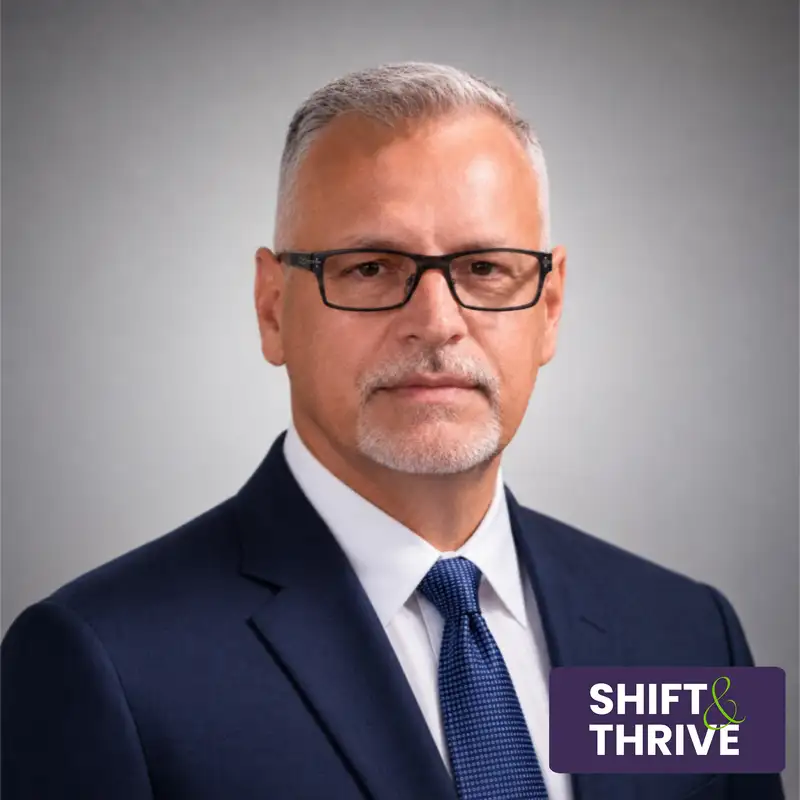
Building a Culture of Trust in Sales & Business Transformation - George Sens - Shift & Thrive - Episode # 115
S&T - George Sens
===
Intro: [00:00:00] In today's business world, change is the only constant, and mastering transformation is the ultimate key to success. Welcome to Shift and Thrive. I'm your host, Natalie Nathanson.
Each week we'll bring you conversations with CEOs who delve into how they successfully drove critical change in their organization. This show is sponsored by Magnitude Consulting, bringing you the thinking power of a growth consult. And the getting it done, power of a full service B2B marketing agency.
I am very excited to speak with today's guest. He is a versatile company builder who has spent, uh, his early career leading sales and P&L in healthcare and pharmacy benefits before transitioning into high tech, where he spent the majority of his career, uh, in disciplines spanning MarTech, Fintech, and automotive tech.
Many of those roles centered around go-to-market leadership, with [00:01:00] his responsibilities ultimately expanding into full company and P&L leadership. Now, with over 25 years of executive leadership, he's built a reputation for breaking down departmental silos and instilling a culture of mutual trust and accountability.
Today, he's ex- bringing his experience back to healthcare, this time in biotech, leading an innovative early-stage company focused on developing new ways to help the immune system better fight cancer. He's the president and CEO of Lurex Bio. George Sens, welcome to the show. Thanks for having me. I appreciate it, Natalie.
I'm very glad to have you. And I know you have led, uh, numerous transformations across a few different businesses, and one that caught my attention was a shift you described in how the organization, uh, went to market, uh, not just in process, but in areas, uh, beyond that. Uh, so wanted to ask you to tell the story of that transformation, and then we can unpack, uh, how that came through.
So [00:02:00] actually, I, I, I thought more about this as we went in, and really wanna say transformation, I-- first thing I do is when I come into an organization like the one you're discussing, and even a, a few others, is don't immediately hit the ground running. I, I like the mantra of sometimes you gotta slow down to go faster.
Well, that applies to leaders, too, uh, in the idea of slowing down to actually observe what's going on. Okay, how are things working today? What's-- how are things not working today, uh, of what we're doing in the process? And so really where the transformation came through is to, to ask the teams as well to do the same thing.
So as an example, a transformation you're talking about where we actually ask the, in the one organization, um, I asked the sales folks and really the go-to-market folks to, to slow down. Slow down in the process because what we were really doing is, uh, hocking a product, okay? We weren't coming in, we weren't coming in to look at solutions.
We weren't coming in to be a, you know, what I like to [00:03:00] call, uh, you know, a, a valued partner or resource. We were a vendor, okay, at that point in time. And so really where the transformation came into play is looking at current processes. They had a sales process in there where they definitely had defined stages that they went through, at least inside of the CRM they did, uh, on, on, uh, what they were doing.
And they supposedly would adhere to a, I think at the time it was a combination of Medic and Challenger, that they went through in a sales process. And the reality of it is what they were doing is very quickly blowing through the part you should be slowing down the most, which is gonna be in that qualification, that discovery, to get to the demo.
Why? Well, the product's gonna sell itself. I've been doing this long enough to know that seldom have I seen somebody get on there and go, "Oh my God, I wanna buy. You don't have to go any further, okay? Here's, here's what I want. I've seen the software. That's enough." So what was happening is they were pitching the software and then couldn't understand why the customer was going dark, uh, on what was happening, you know, and why, why we [00:04:00] were losing so many opportunities.
So what we really did to transform this is, is put a, what I like to call that, that kind of current reality framework in place, where first and foremost, we look at what's their current reality. It's understand how they operate today. It's understand, you know, what their workflow is, you know, their people, their systems, their processes, any constraints, what's actually happening in the business.
We're still not though where we're ready to pitch. Why? Now let's start to peel that back and talk about what the problems are, okay? What's preventing them from achieving the results they would like to have, okay, uh, on what we're getting into. So What I really looked at, and this is where, again, part of that mantra really as a principle is, you know, when the discovery is, you know, like they say, if your discovery is shallow, you sell products.
Okay? When your discovery is deep, you start selling outcomes. That's the biggest thing we go through because then the next idea is before, again, we get to the toolbox, [00:05:00] we talk about what's your desired reality? What does better actually look like for you, okay, that we're gonna go through? Once we understand that, after we've completed those first three steps, we now look at our platform.
Not we're selling software. The platform's your toolbox, okay? We're gonna use that platform now to be able to address what your problems are and to be able to provide that desired reality we wanna go through. Last piece then is once we do that, what's the major impact? Okay? And this is where you gotta understand the people you're talking to.
If it's a CFO, what's the financial impact you're gonna go into? If it's operational, what's the operational impact you're gonna get to? Ultimately, how do I make life easier for you? How do I make life better for you? How do I make life more affordable for you that we wanna go through? So we did that as a transformation, and in the one company, uh, you know, the company consistently over the last previous six years before I had joined was, again, there was heavy level of attrition.
They were losing more than they were bringing in. The business was shrinking. Uh, it was a race to the bottom on [00:06:00] pricing for what we had and what they sold. You could see it every year that the average MRR per, you know, that contract was coming down. Uh, so what we had to do was stop, okay? What-- As a result, nine months later, it was the first time the company actually was growing rather than shrinking that we went through.
Not only was it the first time the company was growing than shrinking, we actually significantly increased the, the average contract value, and we did it in two ways. The first way was MRR. We took the MRR and increased it realistically. I think we took it up twenty, twenty-five percent is what we did on here, and this is a software that was thirty years old.
Uh, but we stopped selling the software and started selling the outcomes for what they were looking for. The second piece we did is we took the contract term, where the average contract term was less than a year. By the time I left the company, it was thirty-three months that we went through. So we had a significant transformation where, uh, you know, we went from negative growth, if you will, where it was we were consistently losing, to [00:07:00] being able to grow the company as far as number of customers coming on board, to be able to increase what our MRR was per customer coming on board.
And more, more importantly, we were able to lock down that revenue for a longer, uh, or an extended period of time. So that was a transformation that had a significant impact, uh, on that organization, and it's something that I've been able to, to really take with me, uh, as I'm learning and apply it to other companies after that one.
Yeah. Well, and I love the, the results, right? They really do speak for themselves and what you're able to achieve on the other end of that. Uh, I like your approach around kinda not coming in kinda guns blazing at the beginning of a new, uh, kinda CEO role and, um, taking time to kind of learn and assess before, before acting.
I think we've-- many of us have had the, the opposite experience, uh, at various points, and so I can appreciate that. Um, I think, you know, seeing the need is kinda the first step. H- can you talk a little bit about how you went about making that happen? And I would imagine there's-- [00:08:00] there was maybe some, some pushback, so I just wanna talk through how you navigated kind of that transformation on the people side.
I have yet to be in an experience where there was a pushback in some capacity that you get through.
I've actually seen pushback come from other teams, okay, within the organization. Could be product, could be success that they're pushing through, um, on what they're driving. And so to really navigate that, like as an example, one of the companies we went into, uh, the senior leadership team of which I was part of, uh, that we had the big belief was get right to the product, get right to the product, show them the product, show them the product.
And it was what we do, what we do, and that's how we kept pitching, pitching, pitching. And finally got them to understand when I was there long enough and had enough data to come back and say, "We're losing opportunities we should be closing all day long." Why? We pitch the product and then sit back and go, "You ready to buy?"
And I go, "That, that's-- It's killing us." And I go, "It's killing us as an organization on what we're doing." I go, "It's killing morale internally because [00:09:00] we consistently lose. We're not growing when we should be winning." And so to really address that, we started at the top, which is change the mindset up top on what we're gonna do.
Let's talk about what we impact. Let's talk about why people should buy us, okay? How we're going to get there. What we do on the back end, we'll get there. They'll see it on how we're gonna address this. But for right now, change the mindset for the product. When it came to the people really then, you start looking at the teams and the individual, let's say, contributors that we want to.
The first thing when you ask somebody to slow down, especially when you're in sales, you can see that look of, you know, fear like, you know, th-this isn't gonna work. You're-- It, it seems so the opposite of what I should be doing. Okay, I need to move deals faster through the pipeline. And the funny part is when you actually explain to people, when you move it so fast through your first three or four steps, I go, "And then you're stunned why it slows down so much on the back end as you get deeper [00:10:00] into it."
Why? Because every step of the way, you should be reminding them Of the issues you uncovered upfront, okay? How you're gonna continue to solve what the problem is. I go, "Because when you get time to negotiate and you're selling a product, what's gonna happen? They're immediately gonna start beating you up on the dollar amount.
I need a discount, I need this. If they even get that far, then they're gonna beat the hell out of you on the term. There's no way I'm gonna do a multi-year contract we wanna go through." So what we really did is, is educate our folks so that they understood that slowing down upfront was actually gonna speed you up on the back end, okay, that we were gonna go through.
The second piece is this is what was gonna keep people from going dark, and this is something else that we talk about where I've had a lot of folks that say, "I don't like negative selling." Me uncovering your problems isn't negative. It is your reality. Here are the problems you have, and here is the impact on your business.
Stating that, not only is it not negative selling, it's [00:11:00] remiss on you for not actually bringing it up as the rep, okay, that you're getting into. And so once people got comfortable with that and people realized, "I'm actually becoming a valued advisor to this prospect rather than a vendor," it changed the mindset, okay?
And as money starts coming in for sales reps and you can see those bonus checks coming in, they look real quick and go, "This works," okay, that we're getting into, "I like it. I'm making more money. I h- my customers are happier. They're stickier. They're staying longer on what we're doing." The processes downstream then are, "I'm gonna communicate more effectively when I hand this off to success so that we're onboarding.
I'm gonna introduce you. I'm gonna get you involved through the process. I'm gonna work with development." And so that's something as we came in from a transformation where I realized that we, we can't transfer, transform one team and not all the teams, okay, that we're gonna get into. And a big part of that is, uh, communication.
Are we effectively communicating across the team so that it stops being [00:12:00] teams that are siloed in one team? Uh, and, and as an example, I always tell folks like football. You know, you've got the offensive side, you've got the defense, you've got your special teams, but at the end of the day, people only care about how many points are up on the board and how many points you kept the other team from scoring, okay?
It's a single team. You either win or you lose. Doesn't mean one can't contribute more, uh, you know, in a, in a certain scenario, or will contribute more. That's the nature of being a team, but it's a team. And that's a mindset we started implementing through that transformation,
Yeah. That makes a lot of sense, and I think this starts to get a bit into, uh, kind of your leadership kind of mindset and style. Uh, so I would love to hear a bit about that. Can you talk about, uh, what's shaped the way that you lead?
Yeah, I'll tell you, I, I'll tell you my style, but I'll tell you what really shaped it. Uh, I, I have had the, and I, and I'll call it really the pleasure of experience a lot of different leadership styles. Uh, I, I, I've seen a lot of folks that manage [00:13:00] and folks that lead. Uh, and I've seen folks that weren't capable of doing either one of them, quite frankly.
And, and some of those people are the ones you learn the most of, because why? You learn what not to do. So you extrapolate, "Okay, maybe this is what I should do on what we're doing here." And so over the years from a style perspective, one of the things that, that is for me is I believe you manage processes, you lead people.
Okay? And I, so, you know, and I, and I've had people say we're sort of splitting hairs. Not really Okay? Uh, and what we get, at least I don't believe that, uh, on what we're getting into. So really my style, and I'll give you an example. You know, I can manage a process that we go through, but when I say manage you as a person, that's where you get the idea of micromanagement.
I lead you. Okay? And so to me, when you have a style, you can have a, what I call a macro style. But when it's micro down to the individual person, that's tailored to that person. Not every- You know, you're not gonna manage or lead everybody the same. Hence the reason you manage a process, you lead people when we get into.
And so [00:14:00] my style really is the fact I believe it, it's, it's grounded on three core principles. You know, mutual accountability. We're accountable to each other, okay, that we're gonna get into. Uh, mutual trust. We trust each other to make the right decision, which means I need to enable you and trust you, whether it's sales, whether it's gonna be finance, whether it's, you know, operations, development, success, anything we're getting into, that you're gonna be able to...
You're gonna manage those processes. You're gonna go, you know, you're gonna do the right thing as we go through. And if you do stumble, that's okay. Okay? Everybody's going to. That we get into, and this is where the trust comes in. The trust comes in that you're gonna be able to sit back and realize and trust me that I'm not gonna sit here and say, "This is what you did wrong, Natalie."
Versus we get into a mindset of how do we do better? So even if we win, even if we got them through, you know, and we got the numbers we wanted, we got the term that we wanted, everything else we're gonna do, and we won, what could we do better? How do we continuously improve instead of [00:15:00] what we did wrong?
Okay? It changes that mindset where you look at that, where it's continuous improvement. Why? Because it's trust both ways, okay, that we're getting into. The final piece is transparency. You're an adult. And it's one thing that's always just kinda driven me nuts with companies is I understand that there's things naturally you can't share, okay?
At all levels, you can't. However, you should be as transparent as possible. I should be able to treat you... If I'm gonna say I want you to act like an adult, I need you to treat you like one. I need to have the trust that if I share information with you, if I actually explain something with you or it goes back and forth, that it stays there.
Okay. On what we're going to get. And so for me, it really is transparency, mutual accountability, and mutual trust as a leadership style. Once people start to realize that You're gonna adhere to those things, what happens? You start to actually trusting to be able to share with you. You create a dynamic work environment where people wanna participate.
Hey, they may... You know, I might not always agree with them as a leader, [00:16:00] but I will always listen, okay? And if I disagree, I'm gonna tell you why. But we're gonna go through. That's a leadership sign. It's where I find success, where, you know, to this day I have people that call me and say, you know, "If you land somewhere that I can come join the team, please give me a consideration.
I'd love to come work for you again." To me, that's one of the biggest compliments as a leader you can have. Yeah. I wanna talk about a couple of those, uh, maybe starting with transparency. Um, and I'm curious if there are any decisions that come to mind where, like, too much transparency kind of was a bad thing or backfired, or how do you kinda ascertain, like, what's kind of the right sized, uh, transparency for a particular situation, team, et cetera?
Yeah, actually I was, uh, I was in an organization where I, I wasn't leading it, but we felt that we wanted to be transparent where we were financially. We were a startup, we were raising money, uh, and we, we agreed as a leadership team, included [00:17:00] that we would be transparent where we were financially and how we were driving this so that people understood our, our thought processes.
We'll create a sense of urgency where they get it. We've got to move faster as a team on things that we're doing. There's ideas where we talk about where we say we got to slow down. We need to slow down, but we need to adhere to it and actually show that we're managing these. And then ideas where we can move a little faster, we need to do that, okay?
As a team on what we're exploring. What happened was when we shared the financials, quite frankly, we scared the hell out of the team, okay? That we went through-- Uh, we, we, we got just the opposite effect. Where we thought we'd have urgency, want to be transparent, people want to know financially. What people don't want to know is that, you know, in, in less than ninety days, we're running out of cash, okay?
If we don't get money in, one of two things is gonna happen. First one, not likely, probably a little overly drastic, which would be we shut it down, okay? The second one is we start skinnying down, okay, on what we're gonna do from the-- from a [00:18:00] people perspective. And that scared the hell out of folks. And so in mindset, when I look at the transparency there, there are times where we were transparent.
I'm not sure that we necessarily, in hindsight, needed to be at that level, um, on what we were doing. Or more importantly, from the perspective of maybe we did need the transparency, but then we got to look at it, how do we deliver it? And so th-this is one of those situations where I'm looking at it going, "Okay, I don't know if the transparency as much was the issue in hindsight when I look at it as much as how we delivered it."
And the way it was delivered, I could look at it and say we got the, you know, again, the complete opposite effect of what we were striving for. We were able to turn it around. We were able to get money in on what we were doing. But we also realized at that point in time that If we were gonna be transparent on financials, it had to be all the time, [00:19:00] not just when things were bad.
Because what happened is, again, people think, "Oh, worst-case scenario." So what we did is change the mindset of we're gonna keep the team informed. Okay, this is where we are financially, this is our growth, this is what we're seeing. So we went over the numbers with the team, and what we saw... Again, we talk about transformation and that, uh, that transparency is we changed the mindset.
Why? We started treating them like stakeholders rather than simply, you know, l- let's call them, you know, employees or doers. "Hey, just go do what you have to do, and you worry about that. You let us worry about everything else." They become stakeholders. And the minute you saw that they became stakeholders, everything we were striving for, it started happening naturally.
Why? People felt that, "This is my company. I need to be able to make a difference now," rather than coming in and saying, "God, is it 5:00 yet? I can punch the clock." Uh, so that, again, the transparency didn't give us the effect we were striving for initially. When we realized that we needed to be transparent all the time, when we delivered that, that actually gave us what we were striving for.
Yeah. But [00:20:00] it took that painful lesson of learning that upfront to see that reaction. Right. Right. We all, uh, we all learn from, from those kinds of experiences and kind of build from there. I think the financial, uh, piece is kind of one of the harder ones to strike that right balance, and I'm thinking of, uh, uh, a friend of mine that runs a, I think a 30-person, uh, company, and had a similar experience where she, uh, kind of shared, I guess, you know, too much too quickly, created some fear, uh, and then realized a lot of that was due to, like, not having the, the team not having enough of that financial literacy.
And so their step back was actually like, "Let's kind of walk you through everything that you're looking at, kind of hear all the com- pieces that make up kind of the company's financials. Here's our benchmarks. Here's a healthy range. Here's..." And then kind of bringing that to, "And here's what you, kind of each, uh, department, uh, can do to impact it."
And then that became kind of their new way forward. So I think, um, right, none of us are, are perfect, and each time one of those situations comes [00:21:00] up, there's, you know, room to correct, and then oftentimes the company does become, uh, stronger as a result. I wanted to ask you about the accountability, uh, piece as well.
Um, and I was just talking with somebody, uh, over the weekend who's, uh, a new manager. She's not new in her career. She's very seasoned, but hadn't kind of managed or led, uh, people explicitly before. Um, and she's leading a team of leaders right now and saying she's not getting the accountability she's looking for, and kind of the, uh, she didn't call it an excuse, but I'll call it an excuse, is that everyone's kind of, you know, too busy for certain things, like kind of reporting on KPIs, things like that.
Um, and just wanna hear kind of how you've handled, uh, kind of building that accountability and kind of the balance of when to be, uh, you know, when there's a valid excuse or not, so to speak. So I actually got pushback from all people on accountability from a corporate attorney that we had. And we were talking and, because we were talking about our HR processes, trying to mature them a little bit, [00:22:00] and he finally stopped me and said, "You know, I, I, you use the word accountability quite a bit."
I said, "Um, okay." And he said, uh, you know, "Don't, don't you think that's a..." You know, in fact, actually I r- I remember I was thinking about this over the weekend more. His exact phrase to me, and I was a little taken aback, was, "Hey, y- this isn't all about, you know, where, hey, you're a sales bro." And I was taken aback, and I actually said, "First I gotta tell you," and he goes, "Yeah."
I go, "I'm not even sure what the hell that means." And I go, "But I'm gonna make an assumption." And he goes, "Okay. That you, you think this is like a boys club where we push and we do stuff." And I go, "Have you looked at my team?" And he, and he goes, "What?" I go, "I'm pretty sure, especially you being the corporate attorney, a little bit of HR, you might wanna be careful with that."
And he's like, "What do you mean?" I go, "Considering my team is 75% female, I'm not sure I'd be talking about sales bro to that team." And he, and he kind of got it, took a step back. And I go, "But..." I go, "W- let's, let's pivot this." And he goes, "Okay." And I go, "It's funny, from the sales side, you don't have any issues [00:23:00] looking at if they haven't hit their goal two quarters, three quarters, four quarters, whatever we wanna say, whatever that measurement is.
You have no issues us having a process managing them out." And he goes, "Well, yeah, that's right." And I go, "Okay, because they're salespeople, and they have a very defined goal that we give very little flexibility to, okay? The words we can't hit that deadline, we can't hit that number, they're not allowed to exist with sales."
And he's like, "Yeah, I get that." I go, "Isn't that weird that you're okay with accountability there?" I go, "Let's pivot over to development. We have a roadmap. They miss two weeks, four weeks, six weeks, a quarter, things slide. Doesn't work. They do release something. It's bug infested, let's say." You know, I explained to him, I go, "The bugs are there, and so what they released, we gotta roll back.
We've gotta fix it." And I go, "You're not comfortable holding the accountability there." "Well, that's just kind of the nature of software." I go, [00:24:00] "Really?" I go, "You're spot on. You know what the nature of that is?" He goes, "What?" I go, "We don't wanna hold people accountable there because we feel like, well, that's not well-defined.
Well, what if you give me a roadmap and we lock in 12 months, it shouldn't be well-defined? When we give a little bit of a fudge factor if you slide, why should I hold you any less accountable than I'm gonna hold the people on the front end in sales?" I go, "Why should we expect in sales, oh, we're gonna turn over people, we're gonna turn leadership over, we're gonna turn them over in marketing, but in these teams we shouldn't.
We shouldn't hold people accountable." And I go, "So help me understand, how do we actually know if we, if we've got poor performers if we don't hold them for any accountability?" And I actually said to him, "So help me understand, how do we hold you accountable? If it takes you three weeks to review a contract, what are you doing that you are so busy it took you three weeks to review this contract for me?"
And he was kind of taken aback. I go, "We should hold you accountable." So yes, I do believe accountability is [00:25:00] there. Why? Because at the end of the day, if we wanna talk about how do we improve, how do we really improve if we don't hold anybody accountable? I go, "So now let's flip this. Me and I have a board, and I gotta actually say to them, 'Don't worry about the financials.
That's not important. You can't hold me accountable.'" And he kind of grinned. He goes, "Well, we know that's gonna ha- not gonna happen." I go, "No, it's not. I have shareholders, okay? They invest money, and I send out their, you know, "Here's your shareholder update," and that letter goes out." And he's like, "Yeah." And I go, "I should just fluff it off?
No." And I go, "That's the difference. If you want people to be a..." And it comes down to that when I say those three things, mutual accountability. I go, "It's gotta flow both ways, but you also have to actually have it." And so when people say, "I'm too busy," okay, that's great because if that busy is actually productive, fantastic.
You know what that means? We need to add more people. Okay? If you're that busy that you can't [00:26:00] actually do the processes we need to really get good insight into this business, fabulous. But let's go the other way. You're busy, but are you actually productive? I could be busy all day long. Doesn't mean I'm actually productive.
They don't, those don't always go hand in hand, and that's something you gotta take a look at too as a leader. Like, you know, you, you mentioned your friend there to say, you know, from an accountability perspective, they could be incredibly busy, but are they actually producing? Right. And if they're not producing, then you look at, okay, let's look at the process.
If the process isn't broken or if the process doesn't need refined, rebuilt in some capacity, now we look at the people. Okay? Is it the people? You can also look at the technology if you say, "Hey, let's get the, the people down one more step. Let's look at the technology." Is the technology the problem? Do we have the right CRM?
Do we have it set up properly that we're moving through so that our processes and our technology align? If everything there [00:27:00] aligns, you get to the third, then you look at it and say, "Now it's our people." That comes down to that review where, like I said, I don't hit the ground running. I come in right away and want to be...
I always tell people, like, Genghis Khan, where heads are gonna start flying in what you're doing. But you do need to look at those three. Let's look at our processes. You know, normally you hear that PPT. I look at the processes, I'll look at the technology, then I'll look at the people to say, "Okay, technology lines up.
If the processes line up, it's that third box." Yeah. The other one I always think about is kind of making sure folks are thinking about when and where to raise their hand early, right? Whether it's kind of accountability tied to, uh, head of metrics or tied to deliverables, uh, is giving people the chance to, uh, raise their hand saying, "I'm, I'm, I'm not gonna get to this," or, "I'm not gonna be able to deliver this," when there's still a chance to do something differently about it, rather than kind of at the deadline or near the deadline.
I think that is a message I've kind of reinforced with my own team, and [00:28:00] it's made a difference, right? Because there's times when somebody else can jump in and help you. There are times when, uh, something came up unexpectedly, and so someone's not getting to something for the right reasons, but at least everyone's kind of involved in that and, and can have that impact.
So I think there are kind of a number of those levers to, uh, to be able to pull on without, you know, making those excuses.
Natalie Nathanson: Hey, this is Natalie, your Shift and Thrive host. After chatting with lots of CEOs, one thing is crystal clear. Leveling up your company means having a killer Go-to-market strategy. That's what my crew at Magnitude Consulting does every day. If you're trying to step up your marketing game, whether it's strategizing, accelerating your pipeline, expanding into new markets, or getting into AI and automation, let's talk.
No pitch, no pressure. Just good conversation. Visit shift and thrive podcast.com/natalie to schedule a time. Can't wait to connect.
, I wanna [00:29:00] shift gears a bit, George, and I know, uh, some, some of the parts of leadership, uh, includes making tough decisions and sometimes about our own careers, and I know you've had, uh, an experience like that, so wanted to see if you could, uh, share that with our listeners.
I did, actually, and I, and it was with an organization that, um, I'm, I'm proud of the time we had. Um, proud of the results within that little bit of time that I was there that we did. But I also realize in hindsight that I can look back that it, it, it probably wasn't a marriage that should have ever taken place.
Okay? We both went through, we were excited. You know, I went through almost a dozen interviews, multiple different people, you know, over Zoom, over, you know, face-to-face that we went to, and the flags were there. There's no ands, ifs, or buts. Okay? In hindsight, I can look at it and go, "Oof." That was, in some instances, painfully obvious.
The problem was we fell in lust with each other that we went through and thought it lined up. [00:30:00] And the reality of what that was, there were three significant issues that never got addressed, okay, that came through. Uh, and for me, those issues were significant enough that it, it made sense for us to part, okay?
And I'm one of these believers that, you know, I do believe in fail fast. You wanna give people an opportunity, uh, that we're gonna go through, but you also fail fast. If it's not working- For the sake of a resume to say was there 18 months versus six as an example? Yeah, it's hard to explain. It's hard to explain when you're 55 years old at the time, and now 56, and you have that short tenure, and you look at it and go...
People go, "Oh, what happened?" And the, the immediate thing is you failed. You know, you're gonna have to start over and go way down again on what you're doing. It's like, you know, I made it, finally made it to the major leagues, and now I gotta go all the way back to Single A. And I look at that and go, in one instance, yeah, uh, where I failed and, and where they failed, and we failed each other is we should have seen that during the interview.[00:31:00]
Okay? Again, when I say slow down to go faster, some of those questions I should have looked at and answers I gotten the same for them. We should have said, "These are flags that need to be addressed now," versus let's get on board and say we'll work it out when we're in there, and that's what happened, and we never did, okay, that we went in.
I now ask those questions. Uh, so even, like, in my current role, and we're currently in a raise, uh, I ask the questions. Some of them are blunt, and like to say it's done professionally blunt on what we get into, but I- they need to be asked, okay?
Because we don't wanna get in here and again have a situation where we're 90 days in a relationship and you realize we never asked that because it made us uncomfortable, okay? And so what's happened? Now we're 90 days in and we have to unwind something, it's gonna be a hell of a lot more difficult to unwind it now than it would've been if we'd have just addressed it back then.
So that, that's the biggest learning I think I've taken away from it, is, uh, I- I'd rather have that be that [00:32:00] professionally blunt, let's be on the same page or at least have a common understanding before we, uh, we move forward together and then regret it once we're, you know, we're lined up. I'm curious to ask, like, what was that, I guess, internal journey like for you once you kind of came to the realization that it wasn't a fit?
Was it kind of an immediate, "Let me take action," uh, kind of what, what was, what was going on for you and how did you navigate that? It was deflating initially, 'cause it's one of those situations where you realize that it's not a fit and you're sitting there and you go, "Ah, crap." Okay? And for the first time in my career, it wasn't where, "Hey, I can recover.
I'm younger." I'm not, and that's a concern. I will tell you that, that doubt for the first time peaked in where it was like, you know, "Jesus, you're in your mid-50s. You know, what, what's gonna happen here?"
So it was one of those situations where you realize, you know, this isn't going to work, okay?
It's not. And it's, it's a scenario of it's no longer an if, it's now a when. [00:33:00] When is the appropriate time that we part? Um, and that's what happened. You know, we ended up working that out where we felt like, okay, it's better now than later that we get through. Uh, because quite frankly, all I could see was that this is going to continue to widen a chasm to where, you know, it's, it's cracks.
We're gonna make it into a canyon very quickly here on what we're getting in. So from that perspective, it was best for them, and I, selfishly, it was best for me to be able to move on well, it sounds like you kind of did, did all the right things in kind of having those tough discussions, and then having kind of the, the trust and the faith in, uh, kind of the, the next, uh, right thing will come along.
And I think that brings us to where you are today, which sounds like a very exciting, uh, place to be. So I wanna talk a little bit about that, and I know it's very different than some of the kinda high-tech, uh, work that you've been involved in kinda more recently in your career. Um, before we kind of talk a little bit about, you know, the, the business side of, uh, of the [00:34:00] company, can you maybe just explain for us in layman's terms, you know, the problem that the company's trying to solve?
Yeah. I, I think most people that if you're on the outside looking in, you look at cancer, and you'll see numbers that come up sur- you know, s- survivability. You're aware of different types of cancers, pancreatic, colorectal, breast, you know, that we wanna go through. We know that. We, we're, we're inundated with commercials, and we see, yeah, Keytruda, this great cancer drug that's making all these great strides and differences.
And in some cancers, it's had a massive positive impact for those, uh, for those patients on that side. What most of us aren't aware of is why, like pancreatic, you ask the average person, say, with pancreatic, and you can see them wince if they know somebody that just got diagnosed from it. Why? There's a five-year survival rate, it's 13%.
Okay? I- I'd say the average person doesn't realize it's even that low. They know it's not good. They know that's a, it's a bad one to have. [00:35:00] What we don't know is why, and that's what's been a little bit of a shocker for me when you look at layman's terms, is to say that the biggest impact on cancers right now, uh, that, that we're seeing a lot of is, uh, immunotherapy.
How do we get your immune system Better engaged. How do we get the immune system to actually attack that cancer? Okay. And realize that, um, and I was using, you know, kind of the, the couple analogies for this as we go through to, you know, for laymen. It's sort of like, you know, picture you work for the CIA, and you know you got a spy internal.
But they're one of us. How do you know? How do you recognize it? What are you doing? For certain types of cancers, real easy for the immune system to recognize it. They can see the spy and go, "I'm gonna go get him or her," okay, on what we're doing. For other types of cancers, certain types of like a pancreatic, certain types of colorectal and other ones, you have basically a scenario where the immune system, uh, and I'm gonna simplify this.
You know, [00:36:00] really it's, there's a couple different areas. But i- in some instances, those cancers are, uh, develop mechanisms where they can evade the im- the immune system or at least heavily suppress it, which means your immune system isn't getting engaged. So all these great therapies that are out there right now, they don't work.
Why don't they work? Immune system's not engaged. It either, you know, is being, you know, fully evaded or s- heavily suppressed by that tumor. The other piece then is exclusion. Tumors actually can develop, you know, picture almost like a scar tissue. Again, where I'm simplifying it, to where the immune system can't get into the tumor And so we've really looked at it as a business to say, "Okay, let, let's take step number one.
Let's make sure the immune system can actually get engaged. It recognizes the tumor, it can get engaged." So first thing for us is we're not even gonna talk suppression yet. How do we get around evasion so that the immune system can see it? And that's some of the things we're doing right now with Lorax, [00:37:00] is to say we believe there are ways, non-genetically, which we're seeing a lot of DNA-based therapies happening right now, non-viral, that we're getting into, where we can actually take the immune system, which has a memory, and be able to say, you know what?
Your immune system remembers flu. And so what we're looking to do is be able to take a, let's say like a synthetic version, if you will, of that, and again, we'll use the flu, and put that marker on that cell surface for that tumor.
And all of a sudden, what's the immune system see? It looks at the tumor, doesn't see cancer. It sees the flu on there and says, "Attack. Time for me to get engaged, and it's time for me to go." That's what our platform was designed to do, and that's one of the things we're in a preclinical stage right now, where we're showing or our goal is to demonstrate that we can, you know, and I'll use that tag, that tumor, that cell surface on what we're going to do, and the second piece is to get the immune system to recognize it and get engaged.
We're not talking yet about, you know, killing it, how it's gonna impact. Let's just [00:38:00] get it to where it recognizes and it's engaged. Uh, that's what we're doing right now because our, our thought process is, and this is mine. I was on with an investor the other day that said to me, "You could fail and still have a significant impact, but would you look at it as a failure?"
And he goes, "Now, I'm gonna take a step back when I say that, because you could look at it like in baseball. You bat 300 in baseball, you're an all-star, and yet seven out of 10 times you have failed." And I said, "Well, I, I'm gonna look at it a little different than you." And he's like, "Okay." And I go, "Let's take the pancreatic survival rate, 13%."
And he's like, "All right." I go What if we could double that to twenty-six just on the first step what we're talking? What if we took it to thirty-nine? And he went, "Okay." And then he, he goes... And I said, "You understand where I'm going with whereas if you're one of those people that has that, you get diagnosed with it, you're really thinking that six out of 10 times fail versus right now you have a 13% survi- uh, chance [00:39:00] to make it five years.
Or would you rather have, here, you have a 39% chance. I don't know about you, I'm gonna take the 39." So for me, it's not a failure. For me, we just tripled the population that actually can make it five years. And I go, "The next goal is how do we get it up over 50?" You stop thinking about my time's limited, I said, because I'm gonna use your numbers back at you.
And he went, "Okay." And I go, "87% of those people right now won't make it five years. 87%. So you talk about failure?" I go, "If we got that down to 61%, then we got it under 50%," I go, "to me, that's a win. And I'm pretty sure those people that are diagnosed with that, they'll take that win all day long as well." I go, "That's how I look at things a little different from numbers, rather than saying it's a failure because we only got to 39%."
I go, "I don't think the, you know, the two or 300% more people that are surviving to that time would agree with you that it's a failure." [00:40:00] That's what we're trying to do with Lorex right now is find ways to where we can attack these tumors where current treatments have little, very little impact, okay? Or, or let's say are very highly ineffective on what we're getting into, and be able to expose these people and give them opportunities to where they can maximize what we're doing.
So like I, I told the investor, even from a financial standpoint, we're not looking to take a slice of the pie, we're looking to make the pie bigger That's actually what we're doing because the market right now, global for immunotherapy or immuno-oncology is, it's $153 billion market. In less than six years, it's forecasted to more than double.
That doesn't include this entire population of cancer, people that are fighting cancer right now. Add them to that pie, it gets that much bigger. So that's how I'm, I look at the leadership in this role as I'm not the scientist. I, I'm building the team of bringing great people on that [00:41:00] are. My goal is to push these folks to get them to how do we take that 13 and turn it into 39.
Yeah. It's amazing to be kind of... I imagine to be working in this kind of an area. Um, and maybe in some ways it's, uh, easier that you're not a scientist, that you can explain this in... You know, the way you explained it made, made a lot of sense to me, uh, not being in the industry. Uh, what have you learned so far about explaining kind of a somewhat technical opportunity, uh, to the different audiences that you're, that you've been engaging?
It's funny because the... When I, when I deal with the healthcare folks, uh, we, I... In fact, I actually have call this afternoon, and I had two last week, where I've got three doctors coming on board our scientific advisory board, and all three of them said the same thing. In fact, the one is a very well-known oncologist that's coming on board, uh, with a somewhat of a specialty inside of GI cancers.
And, and [00:42:00] he actually said to me, "I'm just stunned somebody hasn't done this before." And, uh, it's, it's funny 'cause I say, "You know, it's, it's funny about this thing," is what I go, "I actually had two investors, potential investors this week say the same thing." And I go, "If you think about it, we go back through history, how many times has that phrase been uttered?
I'm just stunned somebody hasn't do this." I go, "I'm pretty sure if we went back 3,500 years to the Egyptians, they're building the pyramids, somebody said to that engineer, a key engineer, 'I'm just stunned somebody hasn't built a pyramid before.' You know, on what we're doing here." And he, and he started laughing and I said, "That, that's the whole idea of how we're, you know, what we're looking to change."
And so from that perspective, it's... I, I talk more outcomes with the healthcare folks, okay? On what we're doing, why we believe we can get there. When you're talking to the laypeople, you've gotta, you gotta flip it around, okay? I'm not getting into there's our assay development and all the, the medical terms I want to go into or the scientific.
I've learned to actually explain it to where [00:43:00] we're staying true to what we're doing, but like the discussion we just had, can explain it where people go, "I get it. Now I see what we're trying to tackle. Wasn't aware that even happened." To the investor, you've got to take it one step further because it is different.
That discussion is different than... In fact, I had it on Friday with a group where they're very heavily real estate and software Through an introduction from somebody, actually one of our board members to them, their big thing was, "Okay, when do we get the revenue? What are we driving here? How are we hitting this?"
And I said, "Listen, here's the difference. Let's, let's stick with software." And he went, "Okay." I go, "I'm not gonna deliver MRR, ARR. You're not gonna see the hockey stick. I'm not gonna talk to you about, you know, this is when we go from a, our net burn to where we're cash flow positive on what we're hitting." I go, "We may never get the revenue, so we actually have to have parallel plans.
One plan is we go all the way and we have a commercialization strategy, and we take it to it." I go, "The second plan is, and we're still hitting the [00:44:00] same milestones for both, but the second plan is we may still be in our clinical stage, one of our phases, and get acquired." And he was kind of taken aback, and he's like, "But you don't hit revenue."
I go, "No, we're not getting to the commercialization." He said, "Well, why would anybody acquire you?" I said, "Well, the acquisitions are happening more frequently now." And I go, "The reason why they're happening more frequently," I go, "There, there's a belief with some of the big pharmas, companies that R&D dollars are being transitioned over to M&A.
Why? Because companies like us can be more nimble. Companies like us can focus on a, on a solution, be able to move, be more nimble on how we're doing it, be able to attack it differently, and not have the overhead that they do, okay, on what we're tackling." So they look at us and say... You know, and again, I, I said, "I'm gonna use it 'cause I know backgrounds for both of these guys were, that were on the call were athletes."
And I said, "Assume we, we get the ball to the 50-yard line." And then they go, "Perfect, we'll take it from here, okay, that we'll run in." I go, "Or, or baseball. You know, I, I get you far enough into the game, [00:45:00] and then the manager comes out and says, you know, 'Give me the bullpen.'" I go, "That's how it's looked at now is we've hit enough data milestones that they can look at that and say, 'It's time for us to take it.
We didn't have to put the money in. You did. It's worth on the M&A side for us to tap you, and, and here's where we're going to.'" I go, "The other reason why they're doing that," and I explained it to them, "is you look at a Merck as an example with Keytruda. Keytruda does 30... I don't know. Let, let's just say 31 billion a year, okay?
That's almost half of Merck's revenue." That patent's expiring soon. That's one hell of a revenue cliff if you're in leadership for them knowing that that's what's coming. Okay? How do you replace that? Doesn't mean we're gonna replace it, doesn't mean somebody else is, but what it means is that they are looking.
Them, you know, the Eli Lillys of the world, the Mercks, the other companies out there are looking at companies like ours to say, "Can you replace that from that perspective?" So that's the difference here when you're looking at from this role versus software, and we go through [00:46:00] development, is really you look at the one core metric you're raising money is...
Or, I mean, there's a few of them, I shouldn't say one. But when you look at what your MRR ARR, how are you growing, how many customers you bringing on, what's the average contract value, you know, and you're looking at those numbers. Over here, it's data-based or science milestones that we're looking to achieve.
I'm curious, are there other, uh, kind of major decisions or trade-offs, uh, that look different while you're kind of managing these, these two paths, uh, of kind of commercialization or kind of early acquisition? It, it is, and it's, it's, it's funny as we go through here is, like with the doctors we were describing this, we're actually going through a process right now where- If you're software, you may outsource some of your development, don't get me wrong, okay?
Own what you're getting in. But the reality of it is you have your core team in-house, and any more with use of AI, a lot of companies are bringing that development in-house rather than outsource. Why? Because what I used to be able to get done in a year with four hundred people, I can get done in six months with [00:47:00] one hundred, okay?
I can bring them internal, I have my costs, and here's what we're doing. Where it's a little different from us is we actually partner, um, actively partner with external labs, okay, to do the research. Why? It'd be cost prohibitive of-- for us to set up our own lab, maintain our own lab, and go through the resource and what we're doing.
And so it, it is different from that perspective that we are looking at trade-offs there. The other piece that we bring on is it's less about, like, on the front end right now, you know, if I'm, I'm looking at software, how do we get our name out there? What do we need to do from a marketing perspective?
What's the go-to-market, how we're doing? Right now, it's less about the go-to-market than it is what do we need to do to be able to go through our stages? Because we could be three, five, six, seven years, hypothetically, in these clinical stages that we're going through. There's no money. There's no revenue.
There's no real go-to-market that we're out there, you know, we're worrying about marketing, we're worrying about sales. What we're worried about is I need to get somebody in from regulatory, you know, a regulatory advisor, okay, that we have to [00:48:00] have in or runs our regulatory affairs. I need the chief science officer that's gonna be, you know, what we're managing here.
Need a CFO that can actually understand and explain to people that this isn't about our revenue growth, this is about us de-risking your investment, okay, that we go through. How do I do that on the software side? Sell more, bring more money in, okay? Let's make sure that, you know, our, our profitability continues to increase, but so does the money that we're bringing in.
On this side, we're hitting those scientific milestones. As we continue to check a box on one, we just de-risk that investment even more. That's the approach you look at here is it's, it's very science-driven and milestone-driven rather than being on the technology side for software where it's gonna be very heavy revenue-driven.
I wanna shift gears a bit, George. We've talked a lot about your business experience and, and insights, uh, related to that. Uh, I'm interested to hear a bit about you kinda earlier in life. So can you share a little bit about, uh, your childhood and maybe, you know, what had the biggest influence [00:49:00] on, on the person and kinda leader you became?
I had a pretty cool childhood from the standpoint of my parents. They were working class folks. My dad was a police officer. My mom, uh, worked in a cafeteria as a lunch lady for our school district, uh, ultimately ran their union that we went into. Uh, but, but the impact really was on my dad when we were younger.
Uh, he, he put a, put a lot of hours in. And, you know, we talk about this today, him and I, on where we are, 'cause my parents are in their, you know, they're 77 and 76, had me relatively young. And so my dad's thought was, "I need to bring as much money in as I can. I need to provide for the family." Uh, and so what happened, the sacrifice was time.
He was putting time into the job, less time in where if I played sports, and I was a pretty good athlete as we were growing up. And so my mom, the compensation or compensate for that was my mom would take me. And I love her to death. She gave me the time. She took things. She tried to fire me up and have these discussions.
But if there's... You know, and I think [00:50:00] she's a hell of a woman. I, I love her, respect her, adore her. But if there's one word you would probably never use to describe or use in, in a sentence with my mom or about my mom is athletic. Okay, that we're getting into. And so I did a lot on my own, and it did mold me from the standpoint of I didn't wait because I, you know, I, I didn't have the income, my parents didn't have the income where, you know, I was going to all the, the different camps, clinics.
I could be coached. I could have all of this. I had to teach myself in a lot of ways on what we did. And so that ha- that has been the same way through life. You know, when people say to me, "How did you make a transition from, you know, MarTech to AutoTech? How did you make the transition from software over to biotech?"
I've been making those transitions for, you know, 50 years on what we're getting into, on what we're driving. Why? Because that's how I was molded. Um, I didn't wait for somebody to, to show me. I went and got it done. And so the, the difference how it's molded me is it's, it's, it's helped me position myself professionally [00:51:00] But it also made me realize at times where I've been guilty like my dad for the time I put in, what I'm doing with my kids.
And so the difference was I sacrificed a lot of that personal time. So my kids are both in college right now. Uh, one's a junior, one's a senior. Both played sports, both sports in college on what they're doing. And my wife and I made the agreement that we were gonna give them everything we could to enable.
Uh, little did I know what that meant from a time and money perspective- ... what we got into. Uh, but we did it. And so it's something that I can look back and say, "Yeah, you know what? I, I was burning the candle at both ends for those years." I will concede that. Uh, however, I also think my kids will look at it and say, I...
They're gonna be that next generation in our family where, you know, I went from being, like my sister and I, the first ones to go through college, my cousins, the same thing that we went through in that family where it was always working. You went out, you graduate high school, you went in the military, you got a job.
We're the first generation to where [00:52:00] college, go get a career, okay, on what you're getting into. And so it's funny to see within a span of two generations, like my kids, it's college, it's the career, here's what we're thinking about, it's graduate school, where that mindset has changed. Uh, and it's all from, I can look at it how I was raised and the impact that, you know, that, that childhood has molded me today as the professional I am.
And I like to think that, you know, the leader I am, but probably most importantly, the father that I was or am. I love hearing that. And, um, I think a bit about the conversation we had earlier around leaders and managers and what we learn to, we wanna emulate, what we learn and wanna do differently, and differently doesn't necessarily mean a poor reflection on, like how our parents did it or how somebody else- Yeah
in, in business did it. Um, but really kind of figuring out what, what works for us and, and how to, how to carry that forth. So thank you for sharing that. I know we're almost at the end of our time. Uh, w- I always like to close with an introspective question, uh, and [00:53:00] ask if there's a piece of advice, uh, that you've been given, uh, that still shapes you today.
Actually, two of them I'll give you real quick, 'cause I know we are coming up on time, is the first one is, and I think you heard me say it earlier, you know, slow down to go faster on what we're doing. Uh, and it kind of reminds me of a, my kids being younger and the movie Cars and Lightning McQueen, Paul Newman's character telling him, you know, "Sometimes you gotta turn right to go left."
And seeing that look of, "What the hell does that... How does that make sense?" Uh, same situation here. Slow down to go faster. I- it is, it is something that I adhere to a- and I, and I've seen success with it. The other piece is when I was younger, when I say younger, not as a kid, maybe let's go back, you know, 15, 20 years, that's 20 years, and I would golf.
Uh, I, I would get very emotional, okay? And I'm stating it politically correct right now versus w- how I really was. And then a buddy pulled me aside one day and said, "Man, you are really good at what you do, and it isn't [00:54:00] golf. So how about just slow down and take it easy?" What I got out of that piece of advice is you, you can be passionate about something, okay?
But it doesn't mean you have to be emotional. Those are two different things, and I was emotional. The other piece from that is I've applied that to where, to folks on another side where it doesn't mean you can't get better at it, okay? You know, you're really good at what you do, and this isn't it. It doesn't have to be that defined.
I said, "I couldn't approve of golf." It's how you want to apply yourself. And so I've, I've used that as part of my, my leadership. You know, when people ask me about that strategy with even people. "Okay, l- let's, let's put a personal business plan together and let's talk about how we make you better." That doesn't mean necessarily just at the job.
What is it you want to accomplish? Is there a way I can help you, the company can help you be a better person, be more educated, be more, you know, articulate, whatever you want to go through, more comfortable having these discussions that we wanna go. Uh, that piece of advice has [00:55:00] really impacted me. And again, it's sort of like my childhood.
It's molded to where I'm at now versus where I was 20 years ago. Yeah, I love that. Uh, and as listeners want to... If listeners wanna get in touch, what's the best way to reach you? Feel free to, to reach out to me either on LinkedIn or, uh, you know, email. I've got my email on there. Either way, give me a holler, drop me a quick note.
Love to engage with them. Wonderful, wonderful. Well, thank you. Uh, this was a, a great conversation, and I love so much of what we discussed, uh, especially the, the through line of y- your leadership style and, you know, how that got formed and how that has, uh, shown up in the different, uh, the, the different arenas, uh, of your, of your career.
Um, so thank you so much for everything that you shared. Thanks, Natalie. I really appreciate it. Yeah, my pleasure. And thank you, too, to everyone who's listening. If today's conversation sparked something for you, and I am sure that it did, please pass this along to another leader, because we know that conversations like this fuel fresh thinking for all of us and help us drive real [00:56:00] transformation in ourselves and our businesses.
So thank you again, George, and this has been another wonderful conversation on Shift & Thrive. I'll see you all next time.
Outro: That's a wrap for this week's episode. For show notes and more visit Shift and thrive podcast.com. A special thank you to our sponsor, magnitude Consulting, bringing you the thinking power of a growth consultancy and the getting it done Power of a full service marketing agency to help B2B companies fuel their growth.
For more information on magnitude and to get your complimentary transformation readiness assessment, visit magnitude consulting.com/. Get ready. Thank you so much for listening. We'll see you next week.
Creators and Guests